Total cost of ownership (TCO) measures the complete cost of acquiring, deploying, operating, maintaining, and retiring a product or system across its lifecycle. For platform engineering, it prevents attractive implementations from being judged only by build cost or license price. section 3.5.1
Build a useful TCO view by including:
- Cloud infrastructure provisioning and usage, including costs at the expected performance and scalability level. section 3.5.1
- Third-party licensing plus administration, installation, upgrades, and the engineering time saved by using the tools. section 3.5.1
- Buy-versus-build trade-offs, including replaceability and the future cost of vendor lock-in, retraining, redesign, or replatforming. section 3.5.1
- Engineering effort, infrastructure, and licensing costs when evaluating the value of a platform capability. section 3.2.2
Platform capability investment
Before building a shared platform capability, compare its engineering, cloud, and licensing costs with expected savings from faster delivery, compliance, or fewer and shorter outages. Record assumptions, choose an investment timeline, and compare returned value with delivery cost through an ROI measure. section 3.2.2
Figure 3.5 Components of value modeling process. These are both subjective and objective measurements that a technical product owner should identify by working with stakeholders and engineers, which will be used to show platform value.
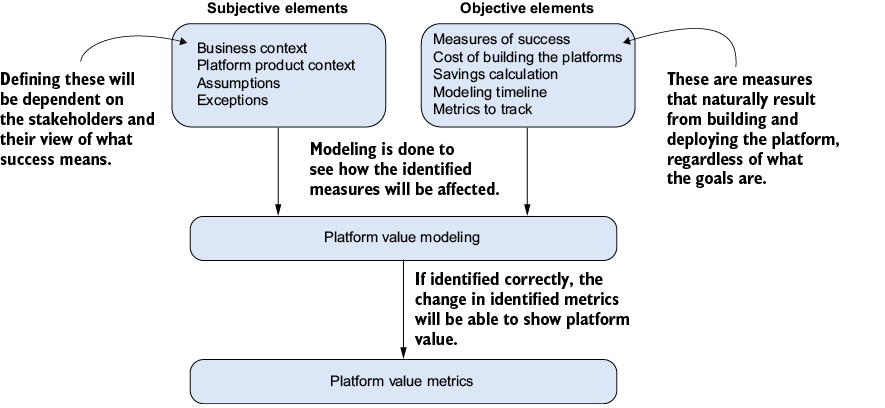
Use the value-model components to combine subjective and objective measurements from stakeholders and engineers. section 3.2.2


