liveBook · Manning

Tree

As explained in 100 Java Mistakes and How to Avoid Them

A tree-like data structure organizes elements into parent-child relationships and ordinarily has no cycles.

A tree organizes elements into parent-child relationships and ordinarily contains no cycles. Recursive traversal processes a node, then recursively visits each child; it is safe when cycles are impossible. section 5.4.2

Treat cycles according to their cause:

  • Track previously visited nodes when cycles are legal or may be present, preventing repeated visits and stack overflow. section 5.4.2
  • Fix the earlier construction mistake when a cycle violates the structure’s invariant; changing correct recursive traversal is unnecessary. section 5.4.2

Recursive traversal failure

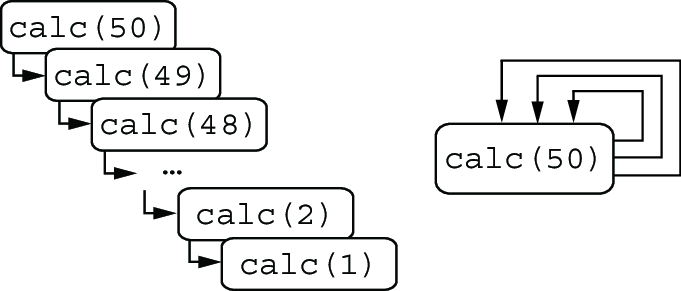
A traversal that revisits a cyclic path can call itself with the same effective state indefinitely, eventually exhausting the call stack. The same pattern appears when a collection directly or indirectly contains itself. section 5.4.2

Figure 5.7 Finite recursion (left) and infinite recursion (right)
figure

Compare finite recursion with infinite recursion to see how an unchanged state prevents termination. section 5.4.2


How 100 Java Mistakes and How to Avoid Them covers it

How deep it goes
Explains recursive traversal and distinguishes legal cycles from construction mistakes, but stops short of implementation code.
Examples
Uses recursive tree traversal and self-referential collection behavior to demonstrate cycle-related failure.
What it assumes
Assumes familiarity with recursive calls and tree-like parent-child structures.
What you can do after
Diagnose traversal failures by checking for cycles and either tracking visited nodes or repairing invalid structure construction.
How it connects
Connects tree traversal with recursion, directed acyclic graphs, cycles, and stack overflow.

Also explained in

Compare how 11 books explain tree →

Related concepts

This explainer was generated by Manning's knowledge graph from the text of 100 Java Mistakes and How to Avoid Them. The section links point to the parts of the book it draws on.








