The Turing test evaluates whether a machine can imitate a human convincingly in conversation. Proposed by Alan Turing in 1950 as the imitation game, it replaces the vague question of whether machines think with an observable challenge: can an interrogator distinguish a machine from a person? section 1.3.4
An interrogator exchanges written messages with an unseen human and machine, then decides which is human. If the interrogator cannot reliably distinguish them, the machine passes. The test evaluates outward behavior—such as language, reasoning, and adaptability—rather than inspecting an internal process. section 1.3.4
Figure 1.5 The Turing Test. A human judge engages in written dialogue with two unseen participants. One is human and the other a machine, but their identities are hidden from the judge. If the judge cannot reliably distinguish the machine from the human based on their responses, the machine is said to pass the test.
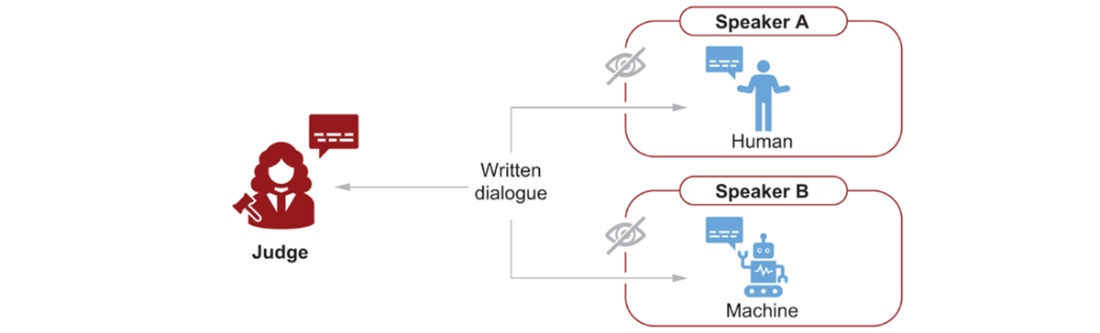
The diagram shows the judge’s written exchanges with two participants whose identities are hidden. section 1.3.4
Passing is an operational result, not proof of consciousness or understanding. Fluent responses can create an impression of comprehension without settling what happens inside the system. As machines improve, judgments about what counts as intelligence also change. section 1.3.4 section 1.3.6
A five-minute conversation
In a 2025 Turing-test-style study, participants selected GPT-4.5 as the human 73% of the time when it was prompted to adopt a humanlike persona, more often than they selected the actual human. This result does not mean that all models are indistinguishable from people in every setting. section 8.5.2
Humanlike fluency also matters outside formal tests: conversational assistants can persuade, instruct, and entertain. The ability to blend into an exchange makes it important to distinguish persuasive appearance from evidence of understanding. section 1.3.6 section 8.5.2


