liveBook · Manning

Underfitting

As explained in Deep Learning with R, Third Edition

Underfitting is a modeling condition in which a model is too simple or insufficiently trained to capture patterns needed for good performance.

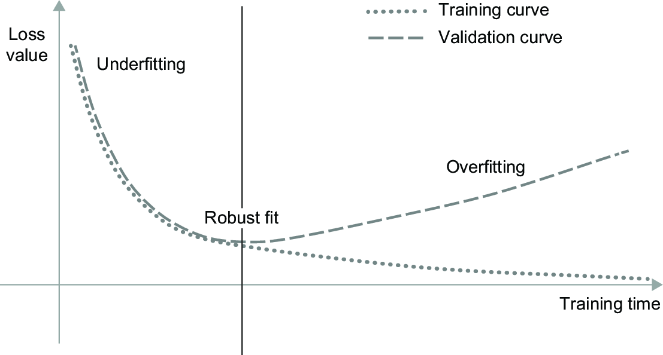
Underfitting occurs while training still has meaningful progress to make: the model has not yet captured all relevant patterns, so training and validation performance can improve together. section 5.1.1

Recognize underfitting through these training patterns:

  • Training loss does not decrease, indicating that training has not properly started. section 5.3
  • Training progresses but fails to beat a commonsense or trivial baseline, showing weak generalization. section 5.3
  • Training and validation loss both decrease, yet the model cannot overfit; this indicates that the model remains underfit. section 5.3

Finding sufficient model capacity

A logistic regression model can have statistical power on MNIST without solving the problem well. Increase capacity by adding layers or making layers larger, then train for more epochs. Monitor training and validation losses and metrics until validation performance begins to degrade; crossing that point confirms that the model can overfit and helps locate the boundary between underfitting and overfitting. section 6.2.4

Figure 5.1 Canonical overfitting behavior
figure

Use the canonical training-versus-validation curve to locate the transition from improving underfit behavior to degrading overfit behavior. section 5.1.1


How Deep Learning with R, Third Edition covers it

How deep it goes
Explains training-loss and validation-loss patterns, then gives capacity-scaling steps without mathematical derivation.
Examples
Uses MNIST, logistic regression, training curves, trivial baselines, and progressively larger neural networks as examples.
What it assumes
Assumes familiarity with training, validation data, loss, metrics, baselines, and overfitting while introducing the diagnosis through examples.
What you can do after
Diagnose underfitting from loss and metric trends, then increase layers, layer size, or training duration to test model capacity.
How it connects
Connects underfitting with optimization, generalization, overfitting, model capacity, validation loss, and baseline performance.

Also explained in

Compare how 7 books explain underfitting →

Related concepts

This explainer was generated by Manning's knowledge graph from the text of Deep Learning with R, Third Edition. The section links point to the parts of the book it draws on.




