Underfitting occurs when a fine-tuned model fails to learn the underlying patterns in its training data well enough, leaving both training and validation loss high. It indicates insufficient learning rather than poor generalization caused by memorizing the training set. section 9.3.4
Use training metrics to distinguish underfitting from overfitting and guide fine-tuning decisions:
- Check whether both training and validation loss remain high; this pattern signals that the model is not learning enough structure. section 9.3.4
- Consider additional training when loss remains high or validation loss has not stabilized, while accounting for training-step count and loss scale. section 9.3.4
- Adjust dataset quantity and quality based on monitored performance; task complexity, data quality, computational resources, and time affect the balance. section 9.1.2
- Separate underfitting from overfitting: rising validation loss alongside falling training loss suggests overfitting, not insufficient learning. section 9.3.4
Reading a fine-tuning curve
Suppose a GPT-3.5 Turbo fine-tuning run shows persistently high training and validation loss. Treat the result as possible underfitting, then review training steps, loss scale, and dataset adequacy before judging the model. section 9.3.4 section 9.1.2
Figure 9.3 Training loss when fine-tuning GPT-3.5 Turbo
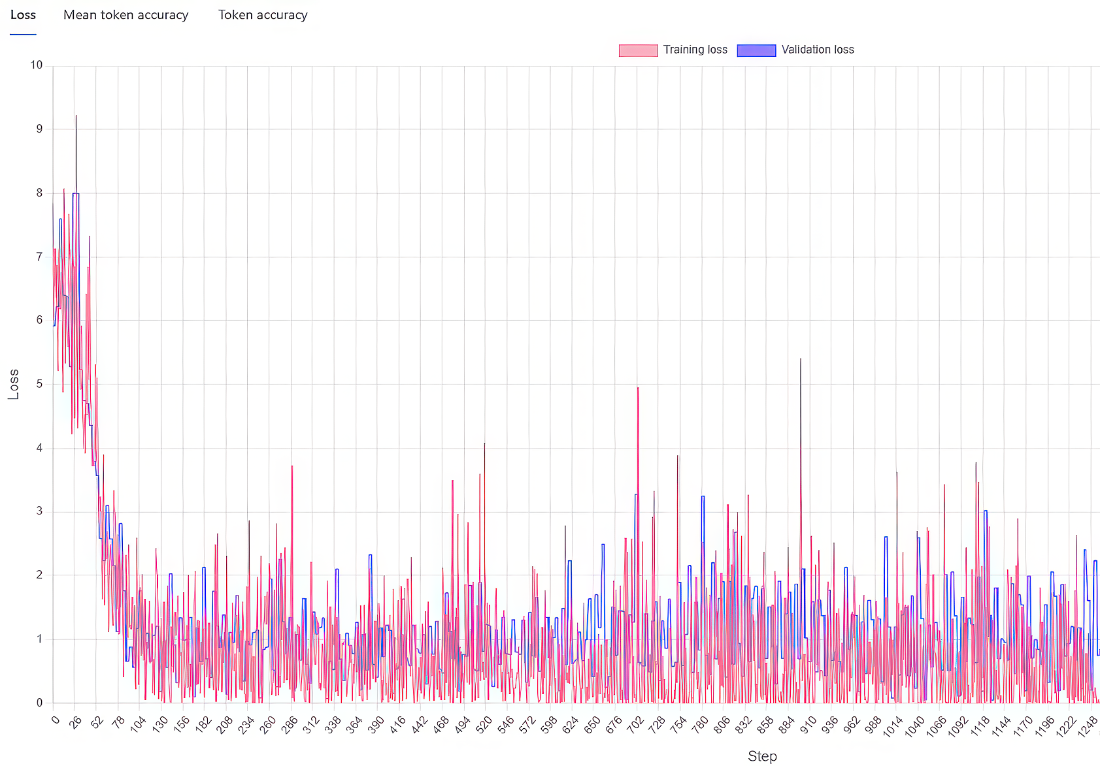
Inspect the training-loss figure to compare learning progress with the expected decrease and stabilization of loss. section 9.3.4






