Underfitting occurs when a model is too simple to capture important relationships between features and the target, producing poor results on both training and new data. It reflects high bias: simplified assumptions prevent the model from capturing useful signals. Unlike overfitting, it is not mainly a failure to generalize from training data. section 9.1.1
Use learning curves to distinguish underfitting from data and variance problems:
- When training and validation curves nearly converge while both losses remain high, treat the pattern as high bias and underfitting. section 9.1.5
- Do not expect more training data to fix this pattern; test a more complicated model instead. section 9.1.5
- Interpret a large training–validation gap as high variance or an unfair data split rather than underfitting. section 9.1.5
- Check convergence first; if the model has not converged or shows underfitting, continue debugging before deeper error analysis. section 9.1 section 9.5
When an underfitted model is harmless
An early foot-detection model in a virtual try-on application sometimes placed shoes on pet paws and toys. Users initially found the mistakes funny, but the model was later improved for conventional scenarios. section 2.4
Figure 9.2 With an increasing number of model parameters, training error tends to become lower and lower while minimizing bias. At the same time, the model variance increases, providing us with a U-shaped validation error.
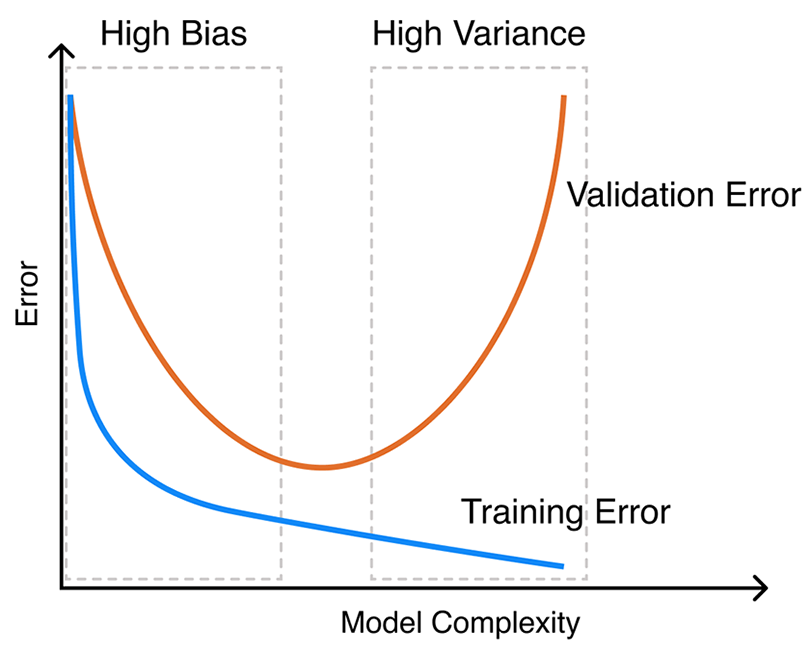
Shows how increasing model parameters can lower training error while increasing variance and producing a U-shaped validation error. section 9.1






