Underfitting happens when a model is too simple or insufficiently trained to learn useful patterns. It performs poorly on both its training data and new data. section 8.13 section 8.17
A useful contrast is overfitting. An overfit model memorizes training examples and struggles with variation in new data; an underfit model fails to learn enough from either set. A good fit captures concepts rather than memorizing details. section 8.13
Use performance patterns to distinguish the three cases:
- Underfitting produces many incorrect classifications on training and unseen data. section 8.17
- Overfitting produces very high training accuracy but poor performance on new, unseen data. section 8.13 section 8.17
- An ideal fit lies between these extremes and generalizes beyond the examples used for training. section 8.13 section 8.17
Studying for an exam
Imagine three students preparing for an exam. One does not study and fails both the practice test and the real exam: this is underfitting. Another memorizes the practice-test answers, scores perfectly there, and fails when questions are worded differently: this is overfitting. A student who understands the concepts may miss details but can solve unfamiliar questions: this is a good fit. section 8.13
Figure 8.26 Underfitting, ideal fit, and overfitting
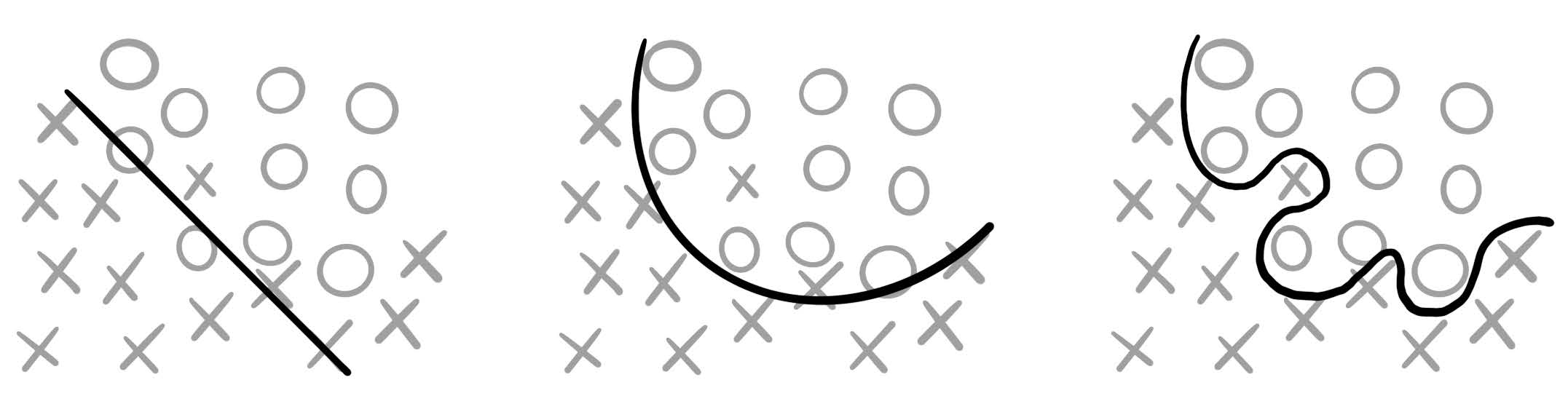
Compare underfitting, ideal fit, and overfitting visually to connect error patterns with model generalization. section 8.17






