Unified memory is a hardware architecture in which CPUs and GPUs share one RAM pool. For developer-local inference, that makes the whole pool available to model weights and avoids the GPU-to-CPU copying overhead common on GPUs with limited VRAM. section 9.3.2
Its practical tradeoffs are visible when choosing local inference hardware:
- A 32GB Apple Silicon system can run Qwen 2.5 Coder 14B at Q4 while leaving room for development tools. section 9.3.2
- Systems with 64GB or 128GB can run larger models such as Llama 3.1 70B, but throughput may become unsuitable for interactive completion. section 9.3.2
- Unified memory handles overflow into the shared pool more gracefully than a 24GB GPU VRAM limit, but it may do so slowly. section 9.3.2
- The architecture improves capacity flexibility, not raw throughput: comparable NVIDIA hardware can generate tokens roughly twice as fast. section 9.3.2
Choosing a local model
Before downloading a model, enter the machine's unified-memory capacity, model, and quantization level into LLMfit to estimate fit, remaining headroom, and expected throughput. section 9.3.2
Figure 9.3 LLMfit software interface.
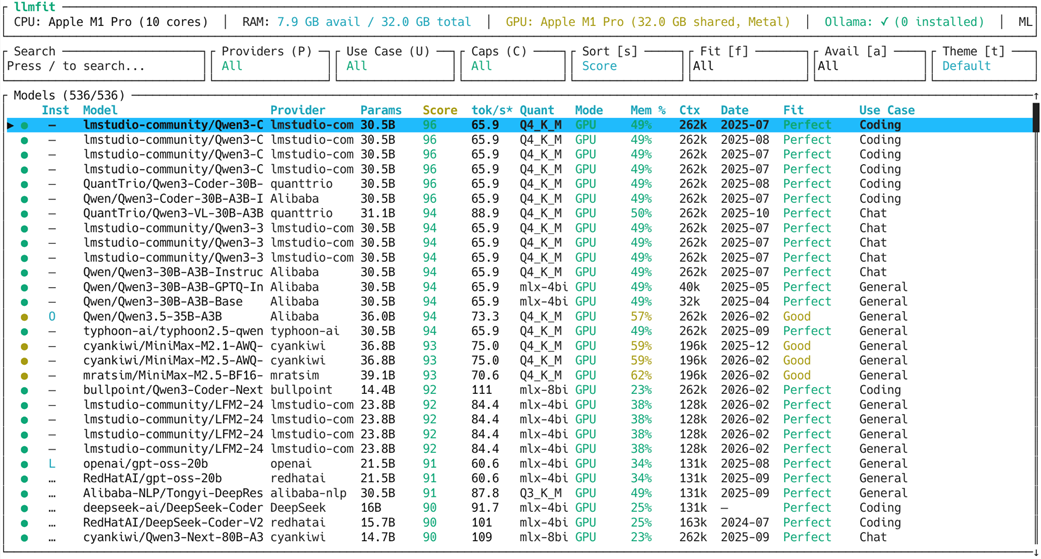
Use the LLMfit interface to evaluate whether a model-quantization combination fits available unified memory. section 9.3.2
