A use case describes interactions that produce an observable outcome. In collaborative modeling, use cases help identify what can happen at a particular moment in a scenario, alongside rules and constraints. section 2.3.3
Use cases become especially useful when a process model leaves important variations unresolved:
- Switch from a timeline-focused technique when discussion branches into multiple what-if scenarios. section 2.3.3
- Explore concrete examples to discover business requirements, acceptance criteria, and governing constraints. section 2.3.3
Reserving seats
A ticketing flow may reserve seats or find no available seats. Examining these use cases exposes rules such as one ticket per seat and adjacent seats for a single reservation. section 2.3.3
Figure 2.19 An example of how to start an Example Mapping. With a user story and the rules, we explore the first concrete example of the rule. On the right side, you can see how to do it either using a virtual board such as Miro or using index cards in a physical setting and drawing with a dry-erase marker on it. From here, we can discuss and find new examples.
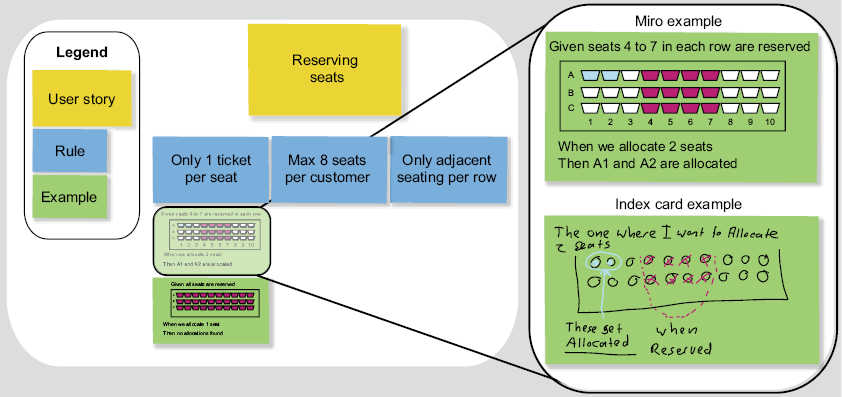
Use the visual arrangement to begin with a user story and rules, then expand them through concrete examples on a virtual board or physical cards. section 2.3.3






