User-centered design keeps users at the center of product work, aligning business needs with user requirements and improving usability through feedback and iteration. It can fit Agile, Waterfall, or a smaller individual project. section 3.4.1
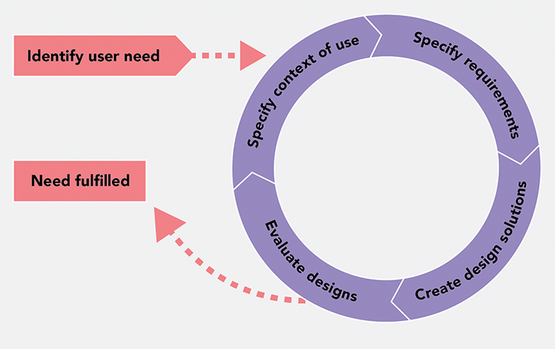
Use four adaptable phases to move from a user need to an evaluated solution:
- Specify the context of use: identify the target audience, their goals, requirements, and circumstances of use. section 3.4.1
- Specify requirements: clarify the business requirements and user goals that define success. section 3.4.1
- Create design solutions through wireframes, visual mock-ups, prototypes, and development. section 3.4.1
- Evaluate designs with users when possible, then incorporate feedback into another design cycle. section 3.4.1
Improving a software feature
A team can request continuous feedback on a specific feature, use that feedback to improve the experience, and begin new research when it reveals an unmet user need. Smaller websites and applications can apply the same cycle to the whole product. section 3.4.1
Figure 3.4 The user-centered design process starts with identifying a user need you are trying to solve and then moves on to how users are going to utilize what you provide, identifying the requirements needed to solve the use case, building a design solution, and evaluating whether the design fulfills the user’s need. If the process does not satisfy the user’s need, it restarts.
Follow the process from identifying a user need through understanding use, defining requirements, building a solution, and evaluating whether it satisfies the need. section 3.4.1


