A technically sensible chatbot can still frustrate people when it makes them repeat information, answer unnecessary questions, or carry the entire process themselves. User-centric design starts with the user’s goal and removes avoidable effort from the interaction. section 1.1.1
Begin by asking what users want to achieve, where they struggle, what information they have or lack, and how they are likely to express their needs. These answers define the capabilities, data, and dialogue needed to help them quickly and frictionlessly. section 1.1.3
Password reset
Suppose users frequently get locked out of their accounts. A user-centered solution must recognize the password problem even when the user never says “password” or “reset,” authenticate the user, gather the required information, and invoke the reset function. The user’s goal drives the rest of the build process. section 1.1.3
Claim status
A burdensome bot asks which claim the user means, even though most users are asking about their own claim and can often be identified through a login or phone number. A user-centric bot uses that context and a reasonable assumption to answer faster, while recognizing that technology alone cannot solve every poor experience. section 1.1.1
Figure 1.2 A delightful experience that uses context and reasonable assumptions to complete the user’s goal quickly. The context could be loaded from a log-in process (chat) or from the caller phone number (voice).
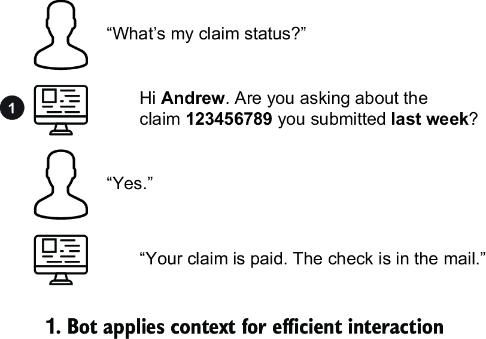
Use the figure to compare a context-aware claim-status interaction with the heavier process-oriented alternative. section 1.1.1


