When an Elasticsearch deployment needs more capacity, vertical scaling increases the resources of its existing machines instead of adding machines. Typical upgrades include more memory, CPU, or I/O capacity; the enlarged machines can also host additional nodes. section 3.6.1 section 3.7
Expanding capacity for multiple indexes
Suppose five indexes require about 10 TB of memory. A vertical-scaling design upgrades five existing servers to 2 TB each, providing the needed total capacity. This is technically feasible, but upgrading may require shutting down servers, causing downtime unless a disaster-recovery system serves clients during maintenance. section 14.3.2 section 3.6.1
Account for these operational trade-offs:
- Treat downtime as a planning concern because scaling up may require taking the cluster or servers offline. section 3.6.1 section 14.3.2
- Avoid concentrating every data copy on one physical machine: a machine failure can affect primary data and replicas even when they occupy different nodes. section 3.6.1
- Compare vertical scaling with horizontal scaling, which adds nodes and can increase throughput, redundancy, and fault tolerance. section 3.2.5 section 14.1
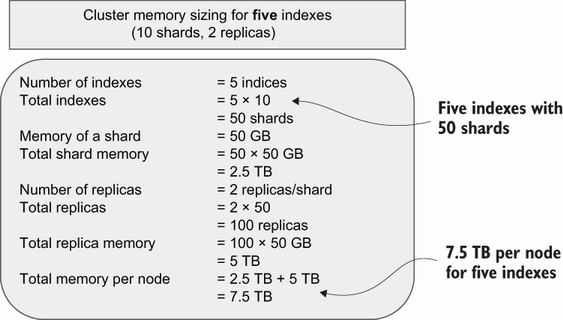
Use the memory comparison to visualize how requirements grow across multiple indexes and why larger machines may be considered. section 14.3.2






