A vulnerability is a weakness in a system, application, or configuration that can be exploited to compromise security. Organizations manage vulnerabilities by identifying them, prioritizing their severity, reducing exposure, and verifying that corrective actions close the underlying gaps. section 6.3.3 section 10.5.3
Useful vulnerability measures connect technical findings to risk and management decisions:
- Track vulnerability counts by severity, such as critical, high, medium, low, and informational, and compare them with explicit reduction targets. section 6.3.3
- Measure gap-analysis coverage to show how much of the security posture has been examined, but pair it with closure data because identification does not prove mitigation. section 5.6.5
- Prioritize externally accessible weaknesses because internet-exposed endpoints, web applications, remote-access tools, and misconfigured cloud services increase attack exposure. section 10.5.3
- Combine vulnerability trends with detection, response, containment, and reporting times to judge whether risk-management improvements are producing operational results. section 6.3.3
From counts to action
TechMed Solutions reduced its vulnerability totals after implementing focused patch management and risk mitigation, yet 20 high vulnerabilities still required prioritized action. TechGuardian Solutions improved gap-analysis coverage from 60% to 85% and reduced cybersecurity performance problems from 20 incidents per quarter to 10, while still needing evidence that identified gaps were closed. section 6.3.3 section 5.6.5
Figure 6.6 On the left, the TechMed risk assessment dashboard before the risk management program is implemented. In this figure, the bottom metrics are displayed as a percentage to indicate the percentage of incidents that were within the predefined target of hours. For example, 40% of the incidents were detected within the 12-hour target detection time. On the right, the risk assessment dashboard after implementing the risk management program.
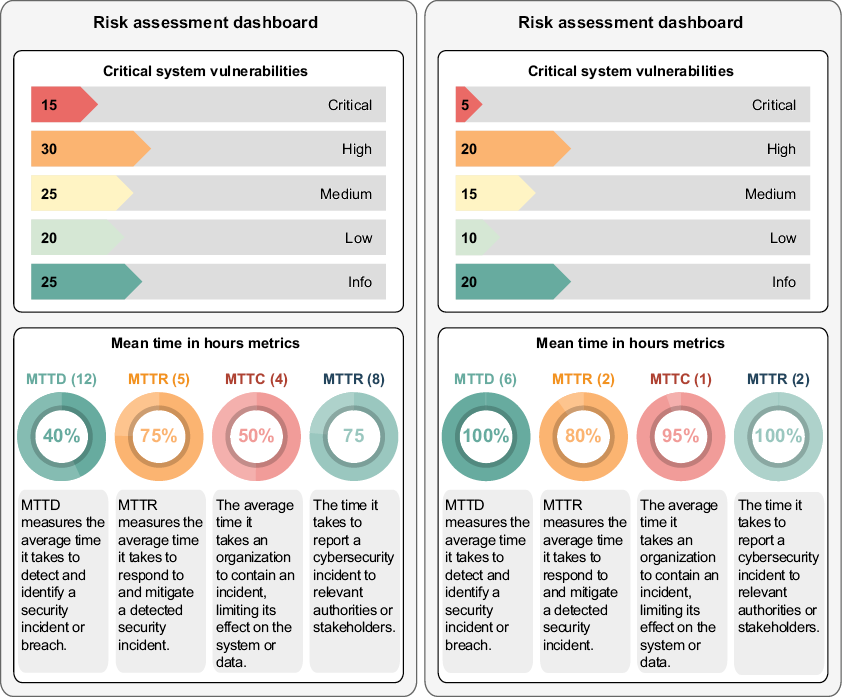
Compare risk-assessment metrics before and after a management program, including vulnerability levels and the share of incidents meeting response-time targets. section 6.3.3















