Wardley Mapping makes an organization’s landscape visible so business strategy, product decisions, and software architecture can stay aligned. It counters generic solutions by grounding decisions in context, customer needs, climate patterns, and the evolution of capabilities. section 12.1.2 section 12.7
Figure 12.2 Wardley Mapping Strategy Cycle, based on Sun Tzu’s five factors and John Boyd’s OODA loop. It includes mapping the landscape, introducing climate patterns, adding doctrine, and making decisions that create a purpose. (Source: https://mng.bz/67PZ. Licensed by Simon Wardley under a Creative Commons Attribution-ShareAlike 4.0 license)
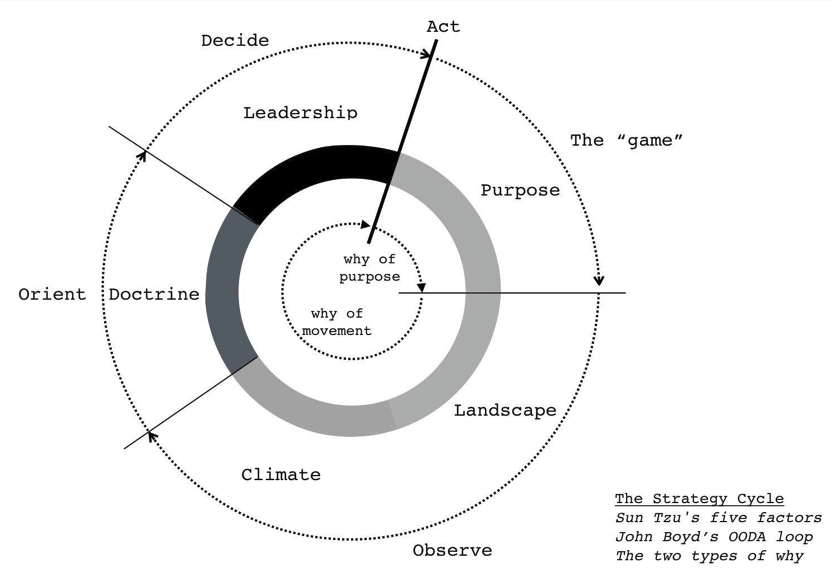
Use the strategy cycle as a shared visual aid: map the landscape, identify climate patterns, add doctrine, and make decisions that create purpose. section 12.1.2
A mapping conversation develops strategic understanding through these moves:
- Map the current organizational landscape instead of beginning with a preferred solution. section 12.1.2
- Introduce climate patterns and doctrine to interpret the landscape and shape possible actions. section 12.1.2
- Use evolution stages to understand where capabilities sit and to tailor strategy to their context. section 12.7
- Turn the shared map into decisions for products, teams, and software design. section 12.7
BigScreen capability discussion
Management and development teams placed capabilities according to their perceived position in BigScreen’s context. The group questioned why planning software would be built internally, marking that concern on the map for further discussion. section 12.1.2

