Imagine an intruder gets into an analytics dashboard. If the internal network treats every service as trustworthy, that small breach can become a direct route to a payment database. A strong perimeter alone cannot stop someone who is already inside. section 11.3.3
Zero-trust networking replaces the assumption that “internal” means “safe” with a simple rule: never trust, always verify. Every request, whether from the public internet or a neighboring service, must be authenticated, authorized, and cryptographically validated before data is exchanged. section 11.3.3
For service-to-service communication, mutual TLS (mTLS) is a two-way badge check. Unlike a conventional TLS connection where the server proves its identity to the client, both parties present and verify certificates. Identity verification is not the same as authorization: a verified service still needs permission for the request. section 11.3.3 section 11.10
Figure 11.5 In a Zero Trust world, you don't take anyone's word for it. mTLS is the "blind date" of architecture: neither party moves forward until both have verified each other's identity.
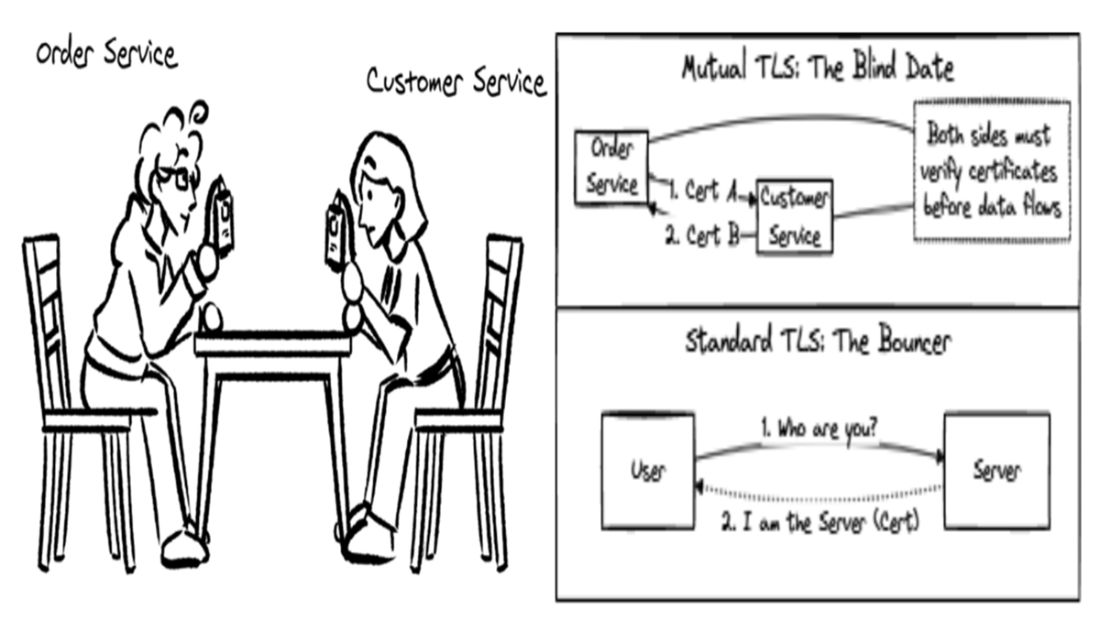
See the two-way identity check between communicating services. section 11.3.3
A service mesh can use sidecar proxies to handle mTLS and identity automatically, including in legacy or polyglot environments. That automation comes with operational overhead: deploying and running the mesh is part of the security cost of distributed services. section 11.10 section 12.6.1
The vendor who reached the registers
In the 2013 Target breach, attackers stole an HVAC vendor’s portal credentials and pivoted from a billing network to the point-of-sale network. Restricting the vendor’s privileges and blocking the route between those networks could have contained the initial compromise instead of letting internal access become a passport to the registers. section 11.7
Put the principle to work with layers, not just a better front door:
- Authenticate and authorize internal requests; use mTLS to verify communicating services. section 11.10 section 11.3.3
- Apply least privilege and network segmentation so a low-level vendor or service cannot reach unrelated sensitive systems. section 11.7
- Limit outbound connections to approved destinations, and check network rules automatically in the delivery pipeline. section 11.7.1
The goal is containment: assume an outer wall can fail, then make the next door require its own proof and permission. section 11.10 section 11.3.3






