An agent action is an ability that lets an agent use a function, skill, or tool to perform a defined operation. Actions extend an agent beyond conversation: they can call APIs, execute code, inspect generated output, or interact with external systems. Their target and effect clarify whether they complete tasks, explore information, communicate, or change the environment and internal state. section 5.1 section 1.2
Actions can be understood and implemented through several practical distinctions:
- Treat plugins as proxies that encapsulate abilities such as API calls or website scraping, while actions provide those abilities. section 5.1
- Generate actions manually, recall them from memory, or follow predefined plans. section 1.2 section 1.6
- Expose actions as skills, tools, functions, or custom actions; terminology varies across agent frameworks. section 4.1.2 section 5.1
- Use sequential actions when later tasks depend on earlier results, and parallel actions when tasks can run simultaneously. section 11.6
A custom file-saving action
A Playground assistant can expose a save_file function that accepts a filename and content, writes the content into an output folder, and reports success. Decorating the function with agent_action and placing it in the assistant_actions folder makes it available when the Playground starts. The same pattern supports additional custom actions, provided each function has a useful name and documentation. section 6.2.2
Figure 1.5 The aspects of agent actions we’ll explore in this book
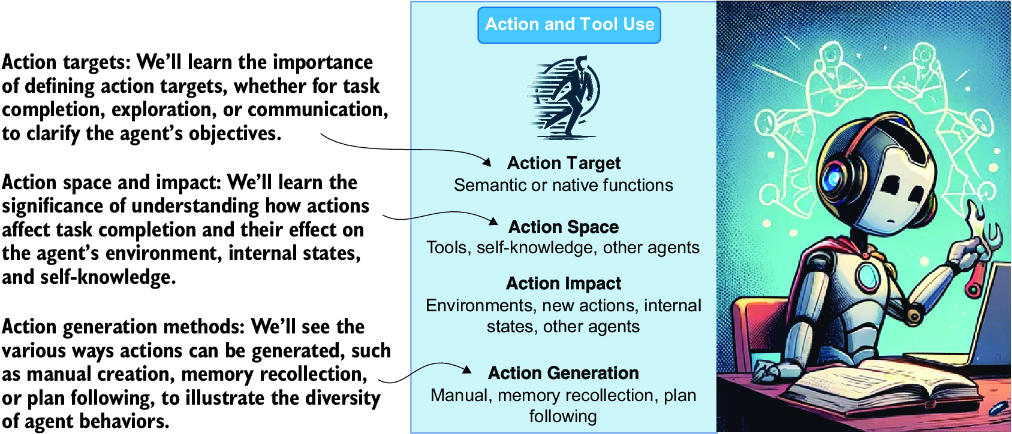
Use the action overview to compare action targets, effects, and generation methods within an agent system. section 1.2












