An action is what an agent does to pursue a goal. It may use a tool, find a resource, hand off to another agent, affect the external world, or change internal state. A tool supplies a capability; the action is the agent’s use of that capability. section 3.3 section 2.4.1
Classify actions by what they help the agent accomplish:
- Retrieve context by searching, querying a vector store, reading a file, or calling a read-only API without changing external state. section 1.3.2
- Complete tasks by taking actions in the world; support reasoning and planning, knowledge and memory, or feedback and evaluation through additional tool categories. section 1.3.2
- Execute actions inside a sense-plan-act-learn loop: sense state, plan, act, evaluate the result, update state, and stop when the goal or termination condition is reached. section 9.1.1
Research planning action
A research-planning agent can first call get_research_sources(), then build a plan constrained to those sources. The function is a tool; calling it is the action. Internal functions can be registered with @function_tool, while external actions can be exposed through MCP. Use in-process calls for internal logic and MCP when a capability belongs to another service, team, deployment unit, or multiple agents. section 2.4.1 section 3.3
Figure 9.1 The core agentic loop. The agent cycles through sense, plan, act, and evaluates the steps until the goal is satisfied or a termination condition is triggered. Internal state accumulates across iterations, giving each cycle more context than the last.
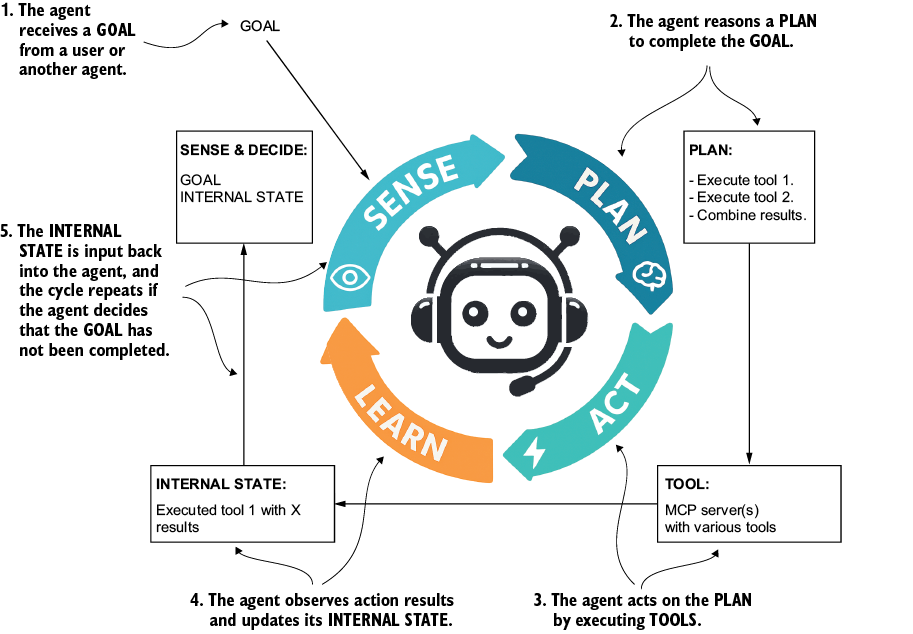
Trace how action connects planning, tools, evaluation, internal state, and termination across repeated agent iterations. section 9.1.1












