An action is a choice an agent makes in an environment. In reinforcement learning, the agent tries actions, receives rewards or penalties, and learns which choices help it reach a goal. A dog sitting after a cue is a familiar example: sitting is the action, and a treat is feedback. section 10.1
The best action is not always the one with the best immediate reward. Actions can form a plan: a chess move that looks poor now may set up a later win. The aim is to choose a sequence with a favorable cumulative reward. section 10.3
Moving through a parking lot
A self-driving car can move one block north, south, east, or west, but not diagonally. After each move, its position changes and it receives feedback. Reaching its owner is desirable; collisions are penalized, especially collisions with pedestrians. The car must learn a route, not just pick a promising move once. section 10.5 section 10.3
Figure 10.7 Agent actions in the Parking-Lot Problem
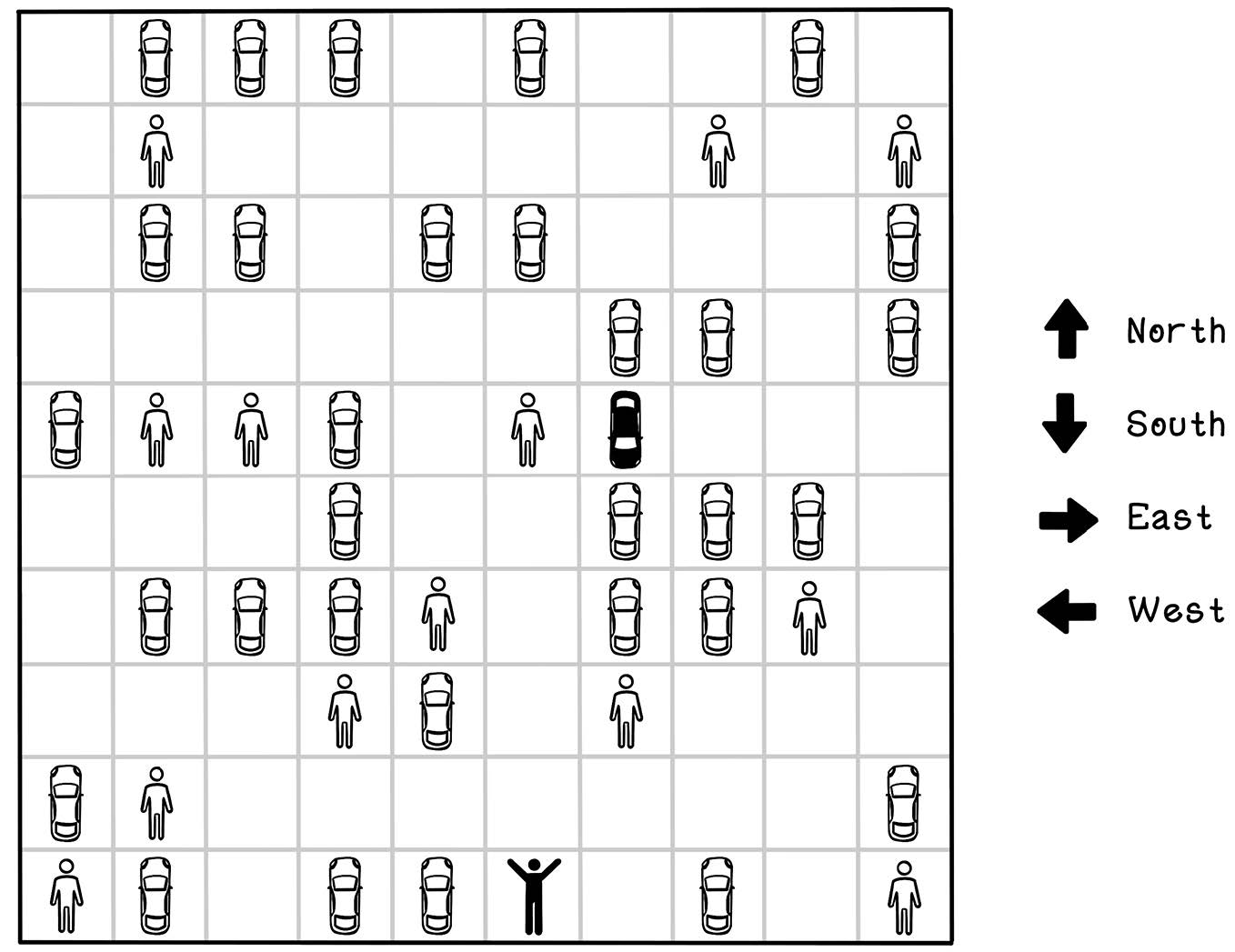
The diagram shows the four movements available to the parking-lot agent. section 10.5
To practice choosing actions, a simulator must accept an action, update the environment’s state, and calculate its reward. Reward design matters: if empty-space moves earn rewards without an effective constraint, the car might move back and forth indefinitely instead of reaching its owner. section 10.5 section 10.4












