An action is the main verb describing the intended effect an operation applies to a resource. Identify it in plain-language operation descriptions before choosing an HTTP method. section 3.4 section 3.4.1
Identify an action by following this sequence:
- Read the operation description and find its main verb. section 3.4.1
- Treat that verb as the action applied to the operation’s resource. section 3.4.1
- List the action’s inputs and outputs, merging information from the steps that use it. section 3.4 section 3.5
- Only afterward map the action to an HTTP method and locate its data in the request or response. section 4.1.2
From operation wording to HTTP
For “Search for products in the catalog,” identify “Search” as the action and “Catalog” as the resource. Represent it as GET /products, place filters in the query, and return product information in the response body. For “Add a product to the catalog,” identify “Add” as the action; POST /products is the usual creation pattern, while PUT /products/{Product reference} requires a client-supplied reference. section 3.4.1 section 4.1.2 section 4.3.5
Keep the raw verb during analysis. Do not replace it prematurely with a CRUD label or an HTTP method; those are later design choices. Context-agnostic input and output descriptions help avoid duplication, and the resource itself usually does not belong in the input list unless multiple instances exist. section 3.4.1 section 3.5
Figure 3.14 We use the operation description’s main verb to identify the action.
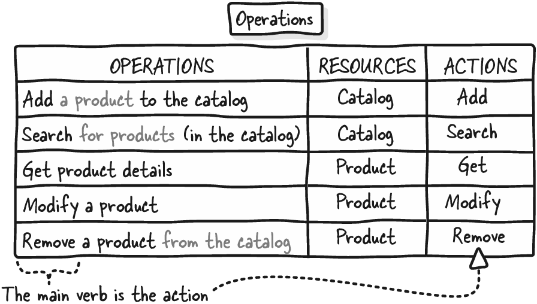
Use the figure to connect each operation’s main verb with the resource it acts on. section 3.4.1












