An agentic structure is a team of specialized agents that collaborate on a complex task instead of forcing one overloaded agent to do everything. Like a human organization, it assigns roles, responsibilities, and communication paths. section 1.4 section 6.1
Splitting work across role-specific agents provides three practical advantages:
- Modularity lets each agent be developed, tested, and maintained independently. section 6.1
- Specialization gives agents limited scopes suited to domains such as planning, mathematics, research, or coding. section 6.1
- Control makes communication easier to inspect, debug, and govern. section 6.1
Common structures organize collaboration in different ways:
- Sequential structures run agents in a fixed order, fitting linear workflows in which each step depends on the previous one. section 6.6
- Hierarchical structures use a supervisor agent to delegate tasks dynamically, enabling conditional execution and reuse. section 6.6
A specialized team
A planner can break down the request, a calculator can handle numerical work, and a fact-checker can verify claims. Each agent has a clear responsibility and limited scope rather than acting as a general-purpose super-agent. section 6.1
Figure 6.1 It’s difficult to be a solo agent with too much on its plate!
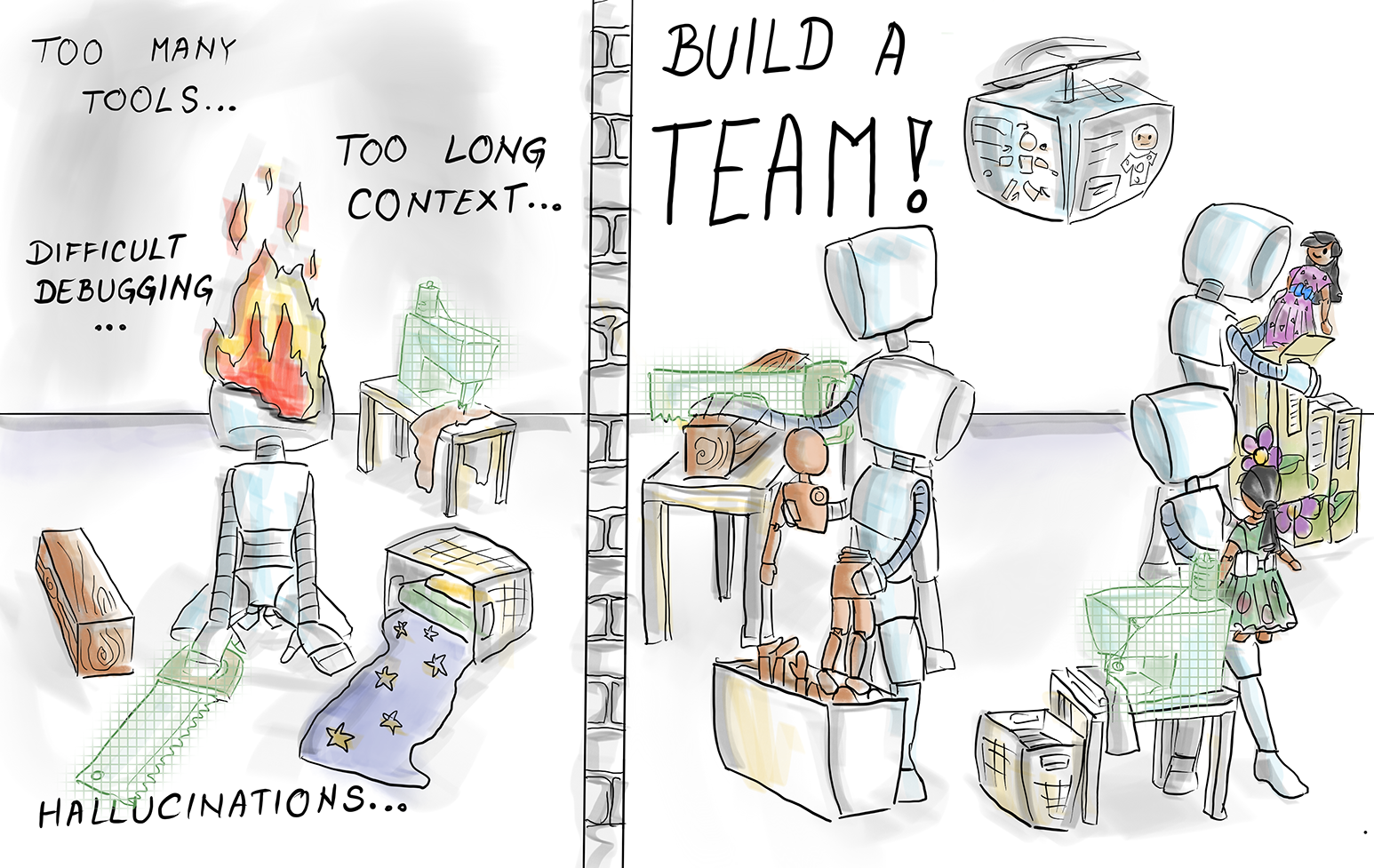
Use the illustration to visualize why too many tools and tasks make a solo agent difficult to control and debug. section 6.1
