liveBook · Manning

Attribute

As explained in Data Pipelines with Apache Airflow, Second Edition

An attribute is a named property of a directory entry that stores a value describing the entity.

An attribute is a named property of a directory entry, stored as a key-value pair that describes an entity such as a user, printer, or network share. Entries reside in a hierarchical directory information tree and are uniquely identified by distinguished names. section 16.3.1

Attributes participate in directory structure and access in several ways:

  • ObjectClasses define entity types and their keys; for example, the person class uses sn for surname and initials as an optional field. section 16.3.1
  • LDAP operations can compare an attribute value, modify attributes, or search for entries matching attribute-based criteria. section 16.3.1
Figure 16.9 Information in a directory service is stored in a hierarchical structure named DIT. Entries represent an entity such as a person and hold key-value attributes about the entity.
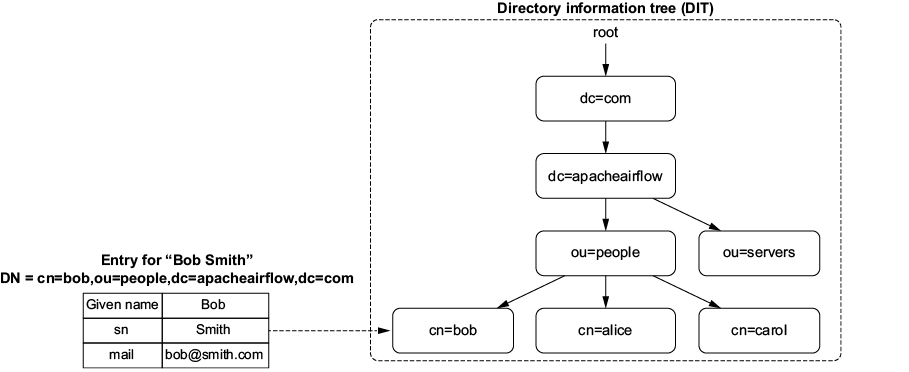
Use the directory-tree figure to see how an entry represents an entity and holds its attributes. section 16.3.1


How Data Pipelines with Apache Airflow, Second Edition covers it

How deep it goes
Defines attributes through entries, ObjectClasses, standard keys, and LDAP operations, without detailing attribute storage internals.
Examples
Uses person attributes such as sn and initials, plus LDAP compare, modify, and search operations.
What you can do after
Evaluate/understand how LDAP represents entities and locates, compares, or edits their attribute values.
How it connects
Connects directory entries with directory information trees, distinguished names, ObjectClasses, and LDAP operations.

Also explained in

Compare how 26 books explain attribute →

Related concepts

This explainer was generated by Manning's knowledge graph from the text of Data Pipelines with Apache Airflow, Second Edition. The section links point to the parts of the book it draws on.























