An audience is the person or group meant to read, interpret, or receive a data story. Designing for that audience changes the task: move beyond what the analyst sees in the data and shape a narrative that helps other people grasp its essence, engage with it, and make decisions. section 1.1 section 7.2
Start with three questions: Who needs this story? What do they need to know? Which data are relevant to that need? A chart is not automatically informative just because it visualizes a table. Select, simplify, and frame the evidence around the audience’s question rather than asking viewers to derive the point themselves. section 1.4.1 section 5.1.1
Calibrate a data story through its audience:
- Adapt language and context to prior knowledge. A technical explanation can be accurate yet fail when readers lack the skills needed to follow it. section 7.1 section 7.2
- Choose charts and supporting context that answer the requested question directly. Make the answer visible at a glance instead of leaving interpretation to the viewer. section 5.1.1
- Distinguish broad and specific groups. Useful labels include general audience, target audience, niche audience, mass audience, general public, executives, and professionals. section 4.2.3 section 7.2
- Use text, images, symbols, annotations, and commentaries to supply the facts and events needed to understand a chart. section 7.1 section 7.6
Pet-event participation
For event organizers planning promotion, raw counts become more useful when expressed as a simple takeaway: roughly 9 of 10 participating pets are cats and 1 of 10 is a dog. The sparse “Other” category can be removed when it does not serve the audience’s immediate question, or retained when the goal is to increase its participation. section 1.4.1
Homelessness chart
A request to identify four regions for funding requires a chart that answers that exact question, not a generic regional overview. Ranking regions by homeless population answers the initial request, but comparing raw counts can mislead when populous regions naturally have more people; a per-1,000-population measure better represents the situation. section 5.1.1
Generative AI can assist with audience-specific wording. A ChatGPT prompt can specify a role, audience, topic, and text type, then be iterated by changing those elements until annotations or commentaries fit the desired context. Treat the tool as support for building context, not as a replacement for deciding what the audience needs. section 7.3 section 7.6
Figure 1.1 The data science flow from the data scientist’s perspective (on the left) and the audience’s perspective (on the right)
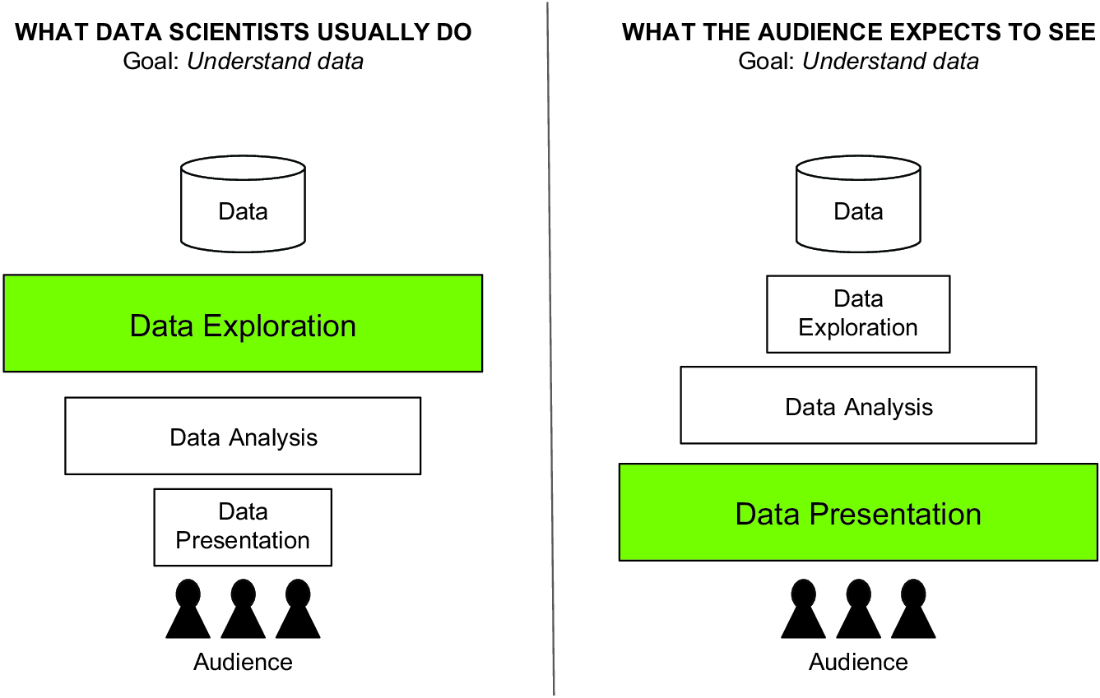
Compare the analyst’s exploration-and-analysis path with the audience’s presentation-focused path; both seek the data’s essence but reach it differently. section 1.1





