An autonomous system operates unsupervised and independently for extended periods without human intervention, managing complete operational episodes itself. Increasing autonomy reduces opportunities for human control and raises assurance, engineering, transparency, documentation, and performance requirements. section 9.2.3 section 9.2
Treat autonomy as a production and governance decision:
- Choose deliberately among assistive, delegative, and autonomous system types because their functional and nonfunctional requirements differ. section 9.11
- Build stronger reliability assurance, system engineering, decision explanations, development records, monitoring, controls, testing, and ethical review as human intervention decreases. section 9.11 section 9.2
- Plan for operational support after release because users may be unable to intervene when an autonomous system fails. section 9.11 section 9.2
Self-driving car
A self-driving car manages the journey from origin to destination after the user selects the destination, while the development and selling team bears moral and ethical responsibility for resulting accidents. section 9.2.3
Figure 9.3 The control flow for a delegative remote control rover [1]
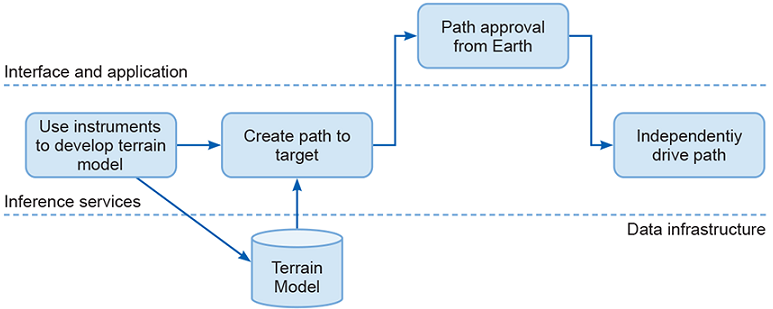
Use the rover control-flow figure to contrast delegative autonomy, where humans review and approve episodes, with fully autonomous operation. section 9.2.2

