A foundational model is a pretrained model that provides a starting point for building task-specific systems. It can support many applications, especially when made available for others to use and adapt. section 1.6 section 5.0
The model is not the finished application. Pretraining produces the base; fine-tuning then adapts it with a smaller dataset, while additional code can constrain outputs afterward. The treatment stays general rather than showing how to code an LLM from scratch. section 1.6 section 5.0
Figure 5.1 One may intervene to change or constrain an LLM’s behavior in four places. The two stages of model training are shown in the middle of the diagram, where the model’s parameters are altered. On the left, one could also alter the training data before model training. On the right, one could intercept the model outputs after model training and write code to handle specific situations.
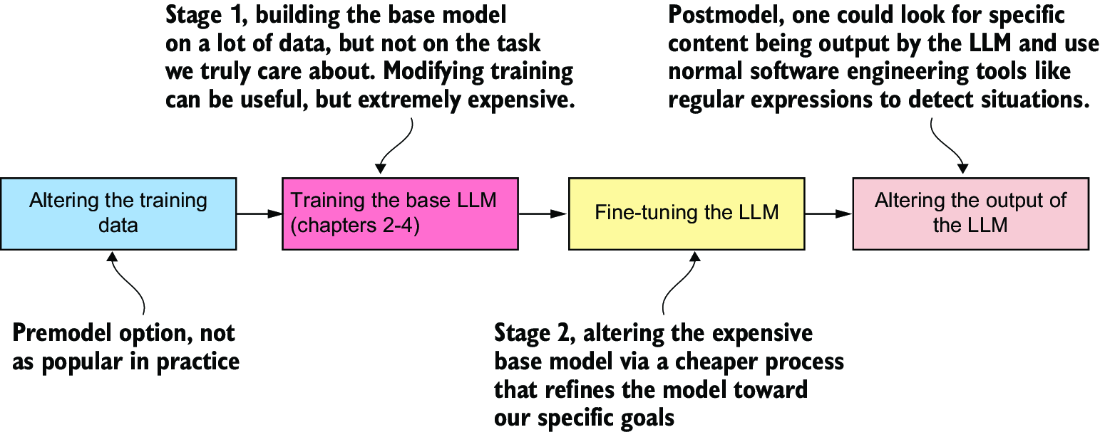
Use the intervention diagram to trace four ways of shaping behavior: changing training data, pretraining, fine-tuning, and handling outputs with code. section 5.0




















