A foundational model is a large machine-learning model trained on large, diverse data and usable across many tasks. It can often be adapted or fine-tuned for a particular scenario. Unlike a data-specific model, it is intended for reuse across datasets and use cases. section 1.1
Figure 1.1 The result of performing linear regression on two different datasets. Although the algorithm used to build the linear model stays the same, the model is different depending on the dataset used.
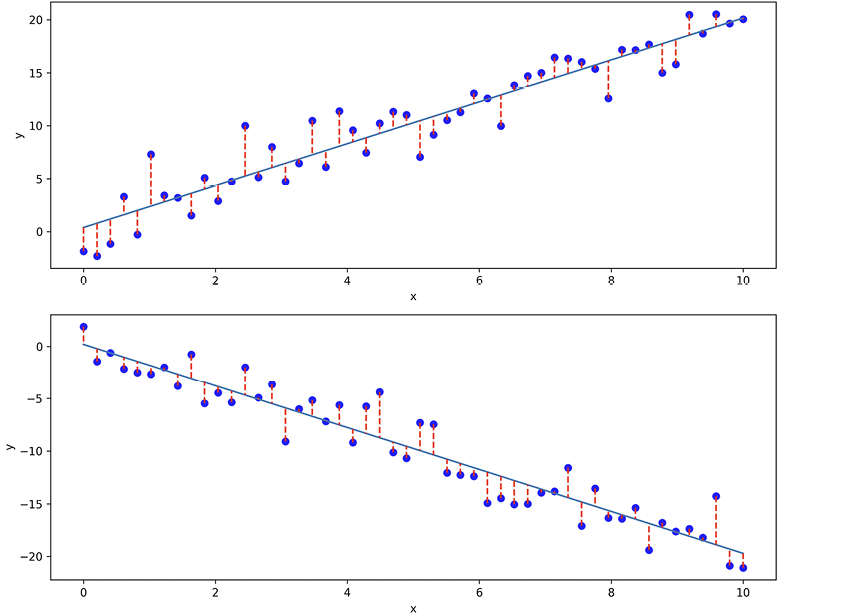
Linear regression uses the same algorithm on two datasets but produces different models, illustrating how training data shapes a model. section 1.1
Foundational models shift work from building one model per task toward loading a reusable model and applying it immediately. In time-series forecasting, one model may handle different frequencies, seasonality, holiday effects, multiple series, anomaly detection, or classification. Derivatives of the transformer architecture power many such models. section 1.0 section 1.5
Evaluate the approach against the demands of the forecasting problem:
- Use zero-shot forecasting when the model predicts a new dataset without training on it; fine-tune when a few training steps can specialize it to the task. section 2.11
- Prefer it when data is scarce, rapid deployment matters, or one model must be reused across many datasets. section 1.3.1
- Check frequency, forecast horizon, multivariate support, exogenous features, privacy, hardware, and infrastructure before adopting it. section 1.3.2 section 2.9
- Compare its predictions with data-specific alternatives using explicit metrics rather than assuming general training guarantees the best result. section 1.3.2 section 2.8
Daily temperature forecasting
A tiny N-BEATS model pretrained only on monthly data produced weaker zero-shot forecasts for daily Australian temperatures than a model trained specifically on the daily dataset. The zero-shot model achieved MAE 2.59 and sMAPE 8.69%, versus 1.34 and 4.87% for the data-specific model. section 2.8




















