Need an LLM for a specific task? You usually do not need to train one from scratch. A foundation model supplies pretrained weights that you can adapt; choosing the right starting model can make or break the project. section 4.0 section 4.1
A foundation model starts as an untrained model trained on a large, general-purpose corpus. That pretraining gives it broad language patterns rather than expertise in one task. Finetuning then updates it on a smaller, curated dataset for a task or domain; prompting can further steer the form of its responses. section 5.2 section 5.2.2
Figure 5.1 The training life cycle of an LLM. We start by creating a foundation model based on a large corpus of text, which we later finetune using a curated dataset for a specific task. We can then further improve the model by using the model itself and techniques like prompting to enhance or enlarge our curated dataset.
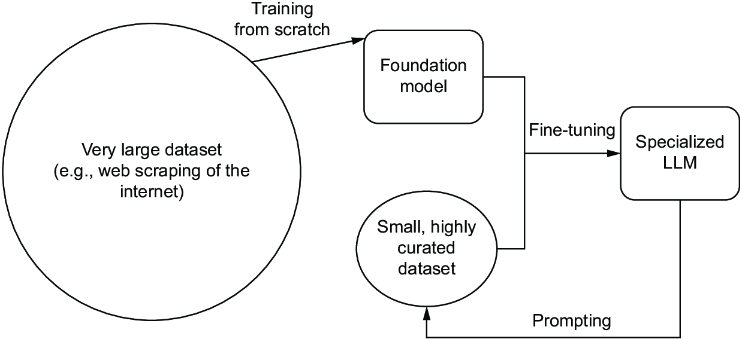
The life-cycle diagram places the foundation model between broad pretraining and task-specific finetuning, with prompting as a later step. section 5.2
Treat the starting model as a practical choice, not just a benchmark winner:
- Check how it was trained and what data it saw; that history helps determine whether it suits your task. section 4.1
- Prepare training data, a tokenizer or other text encoder, and evaluation data alongside the model. section 4.0
- Budget for the route you choose. Initial pretraining demands substantial computation; finetuning generally uses a smaller dataset and fewer resources. section 5.2 section 5.2.2
From broad language to a specific task
A model pretrained on sources such as Wikipedia, books, or internet text can be updated with task-specific data for sentiment analysis, text classification, or question answering. The broad training supplies a starting point; the smaller update directs it toward the job. section 5.2.2




















