A black box is a software component whose implementation or reasoning remains opaque to its users. Working code can still be difficult to modify, debug, or trust when its design is not understood. section 1.3.2
Treat black boxes as boundaries that require deliberate investigation:
- Use AI to explain an unfamiliar system and build a mental model before asking it to generate changes. section 1.3.2
- Map service nodes and edges to distinguish custom code from commodity components and vendor systems. section 9.1
- Inspect inbound, internal, and outbound connections because vendor latency, failures, and trust boundaries become production concerns. section 9.1
Figure 1.4 A developer stands at a fork. One path descends to "coder mode," where they say, "build X for me," outsource understanding, and find the ground crumbling. The other path climbs to "engineer mode," where they say, "explain X to me," and build a mental model with each step. The same person, using the same AI, gets two different outcomes depending on which mode they choose.
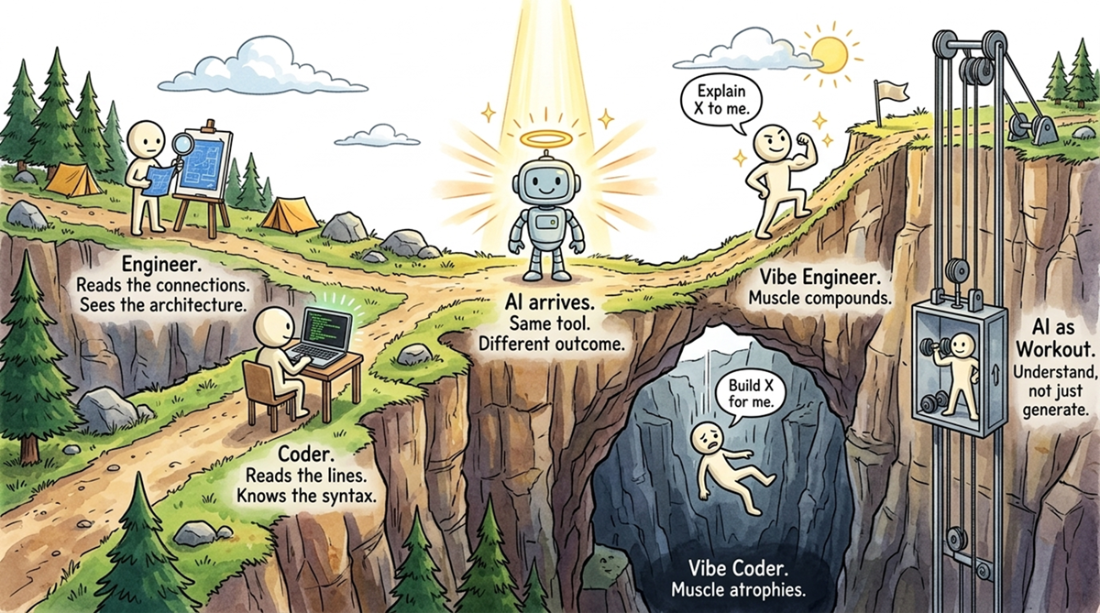
Compare coder mode, which inherits an opaque implementation, with engineer mode, which uses explanation to build understanding. section 1.3.2






