A cap table, or capitalization table, records a private company's ownership: who holds its shares or other equity interests. It makes the ownership structure behind a financing round visible. section 12.2 section 12.4
Use the cap table to reason about:
- Ownership stakes held by founders, investors, or investing entities. section 12.2
- A special purpose vehicle (SPV) appearing as one investor when it pools several angels, while its individual limited partners hold stakes in the SPV. section 12.2.2
- Dilution: each funding round adds shares and reduces existing ownership percentages. section 12.4
An angel syndicate on the cap table
Several angels form an SPV to invest jointly in a start-up. The start-up lists the SPV on its cap table rather than listing every limited partner separately. The lead investor manages the formalities and represents the pooled investors. section 12.2.2
Figure 12.2 A lead investor’s job is to represent all investors when forming an SVP that will be registered on a start-up’s cap table.
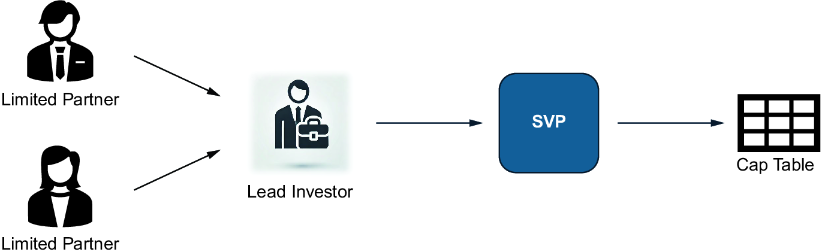
A figure shows how a lead investor forms an SPV that is registered on the start-up's cap table, clarifying the relationship between pooled investors and the company. section 12.2.2

