liveBook · Manning

Capacity planning

As explained in Think Like a Software Engineering Manager

Capacity planning is the process of estimating the amount of work a team can complete during a period after accounting for constraints and non-delivery activities.

Capacity planning estimates how much work a team can complete in a period after accounting for holidays, vacations, on-call duties, buffer days, and meeting time. It compares available capacity with estimated work so commitments remain realistic. section 11.3.3

Use capacity planning to:

  • Size proposed work before committing to it. section 11.3.3
  • Expose overcommitment instead of hiding capacity constraints. section 11.3.3
  • Balance workload and respond to signs of burnout. section 3.2.8
  • Negotiate which lower-priority work should move to a later period. section 11.3.3

A quarter with too much work

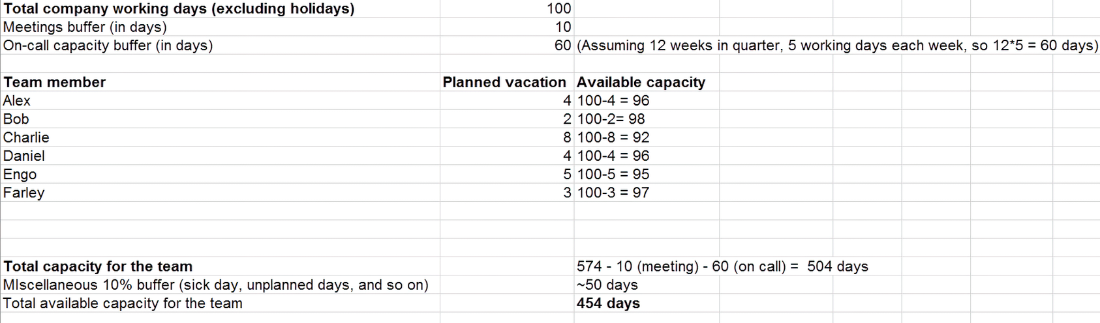
A team sizes twelve features as S, M, or L, then calculates quarterly capacity after accounting for holidays, vacations, buffer days, on-call responsibilities, and meetings. When the proposed workload exceeds capacity by 106 days, the team negotiates to defer less-critical features to the next quarter. section 11.3.3

Figure 11.4 A sample capacity-planning sheet
figure

Inspect a sample capacity-planning sheet showing how available engineering time is estimated. section 11.3.3


How Think Like a Software Engineering Manager covers it

How deep it goes
Includes feature sizing, capacity factors, overcommitment detection, and negotiation over deferred work.
Examples
Uses S/M/L feature sizing, a capacity-planning sheet, and a twelve-feature proposal exceeding capacity by 106 days.
What you can do after
Evaluate commitments, identify overcommitment, and negotiate realistic feature deferrals with cross-functional partners.
How it connects
Connects capacity planning with feature sizing, workload balancing, negotiation, prioritization, and burnout prevention.

Also explained in

Compare how 3 books explain capacity planning →

Related concepts

This explainer was generated by Manning's knowledge graph from the text of Think Like a Software Engineering Manager. The section links point to the parts of the book it draws on.
