liveBook · Manning

Certification authority

As explained in Acing the CCNA Exam: Volume 2 Advanced Networking and Security

A certificate authority is a trusted entity that issues and verifies digital certificates.

A certification authority (CA) is a trusted organization that issues and verifies digital certificates. Websites use certificates to prove their identity and distinguish legitimate sites from imitations. section 11.3.3

A CA supports secure website connections by:

  • Enabling browsers to check a website certificate against a trusted CA. section 11.3.3
  • Supporting HTTPS, the encrypted version of HTTP, after certificate checks succeed. section 11.3.3
  • Prompting a warning when certificate verification fails or potential risks are detected. section 11.3.3
Figure 11.6 Digital certificates are used to verify the authenticity of websites. In Chrome, a padlock next to the URL indicates a secure connection via HTTPS. Clicking on it shows more details, such as information about the certificate.
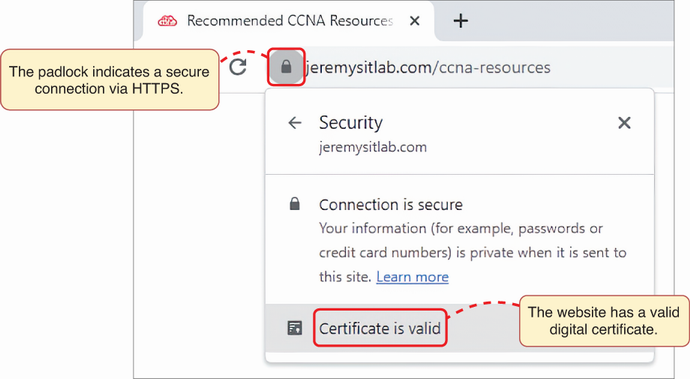
Use the browser padlock to inspect a website’s secure HTTPS connection and certificate details. section 11.3.3


How Acing the CCNA Exam: Volume 2 Advanced Networking and Security covers it

How deep it goes
Defines certificate issuance, verification, browser checking, and warning behavior without detailing certificate-management internals.
Examples
Uses Chrome’s padlock indicator and certificate details as the concrete verification example.
What you can do after
Evaluate website identity through browser certificate indicators and recognize warnings when verification fails.
How it connects
Connects digital certificates with website authentication, browsers, HTTPS, and encrypted communications.

Also explained in

Compare how 8 books explain certification authority →

Related concepts

This explainer was generated by Manning's knowledge graph from the text of Acing the CCNA Exam: Volume 2 Advanced Networking and Security. The section links point to the parts of the book it draws on.





