A certification authority (CA) is a trusted entity that verifies control of a domain and digitally signs a certificate for it. Browsers use that certificate as proof that a website belongs to the domain rather than an interceptor. section 12.4.2
A CA matters when deploying a public web app because it:
- Enables browsers to trust an HTTPS connection after the server presents a valid certificate. section 12.4.2
- Requires proof that you control the requested domain, commonly through DNS configuration. section 12.4.2
- Rejects certificates for domains you cannot control, such as an app's default Elastic Beanstalk domain. section 12.4.1
Requesting a certificate for a deployed app
After pointing a custom domain at an Elastic Beanstalk app, request a public certificate in AWS Certificate Manager. Enter the domain, add the CNAME records ACM provides to the domain's DNS, and wait for ownership verification. ACM can then generate and periodically renew the certificate. section 12.4.2 section 12.4.1
Figure 12.11 ACM shows CNAME records to add to your domain’s DNS to prove ownership.
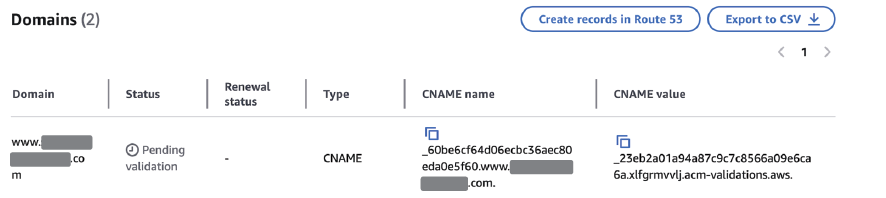
Inspect the ACM CNAME records used to prove domain ownership. section 12.4.2







