Chain-of-thought (CoT) is a sequence of intermediate natural-language reasoning steps between a problem statement and its final answer. In reasoning-model distillation, these traces carry the teacher’s problem-solving strategy: decomposition, applied techniques, and verification. The student learns to reproduce that behavior through supervised fine-tuning on generated text rather than matching token probabilities. section 8.5.1 section 8.9
CoT functions as a practical transfer mechanism:
- Expose intermediate decisions instead of transferring only final answers or per-token logits. section 8.5.1
- Train a smaller student with the teacher’s complete reasoning traces using the standard next-token prediction objective. section 8.5.1
- Use curated, verified-correct traces so imitation avoids the exploration burden that makes direct reinforcement learning difficult for small models. section 8.7.3 section 8.9
Summing the first 100 primes
A reasoning model may identify the primes, recall that the 100th prime is 541, select a summation strategy, calculate the result, and verify that the answer is 24,133. The useful training artifact is this coherent trace, not the probability assigned to each next token. section 8.5.1
Figure 8.27 Performance (AIME 2024) scales smoothly with model size for distilled models. Qwen-Math bases consistently outperform Llama bases at similar sizes, showing that the base model’s pre-existing capabilities interact with distillation quality.
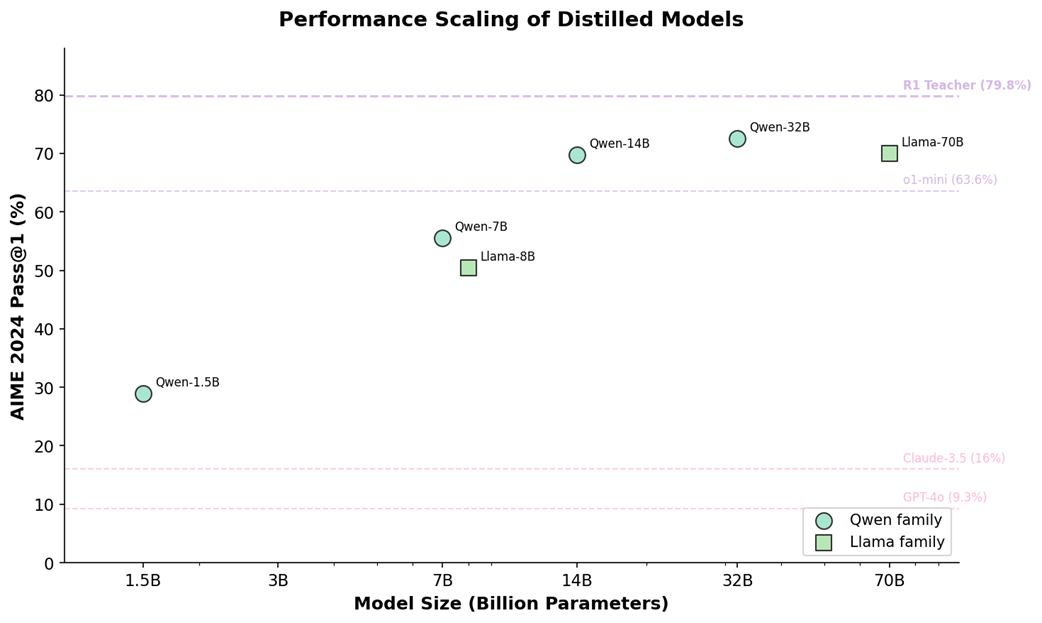
Compare how distilled-model performance scales with model size and how the base model influences the quality of transferred reasoning. section 8.7.3