Chain-of-thought prompting asks a language model to produce intermediate reasoning before its final answer. It turns a direct request into a structured task: decompose the problem, inspect dependencies, adapt decisions, and then act. The technique can improve correctness on complex work, but newer reasoning models often perform this deliberation internally, so explicit step-by-step instructions are now a useful hint rather than a guaranteed switch. section 3.6.1 section 6.3
Use chain-of-thought as an engineering control rather than an instruction to trust unverified explanations:
- Give the model grounding tools such as tests, compilers, or MCP servers, and audit the visible reasoning trace. section 3.6.1
- For coding changes, require analysis of the current logic and dependencies, identification of old API calls, and a search for relevant examples before implementation. section 3.6.1
- Treat “let’s think step by step” as a low-cost reliability aid, then validate its effect with a benchmark instead of assuming it works universally. section 6.3
From direct coding action to a staged plan
Instead of only asking to refactor process_payment for the StripeV3 client, prompt for analysis of existing logic, dependency checks, identification of legacy API calls, and relevant context before changing code. In text-to-SQL work, step-by-step prompting is tested alongside schema descriptions, column descriptions, and recent queries using the BIRD dataset. section 3.6.1 section 6.3
Figure 3.12 Cline drafting plan of the execution.
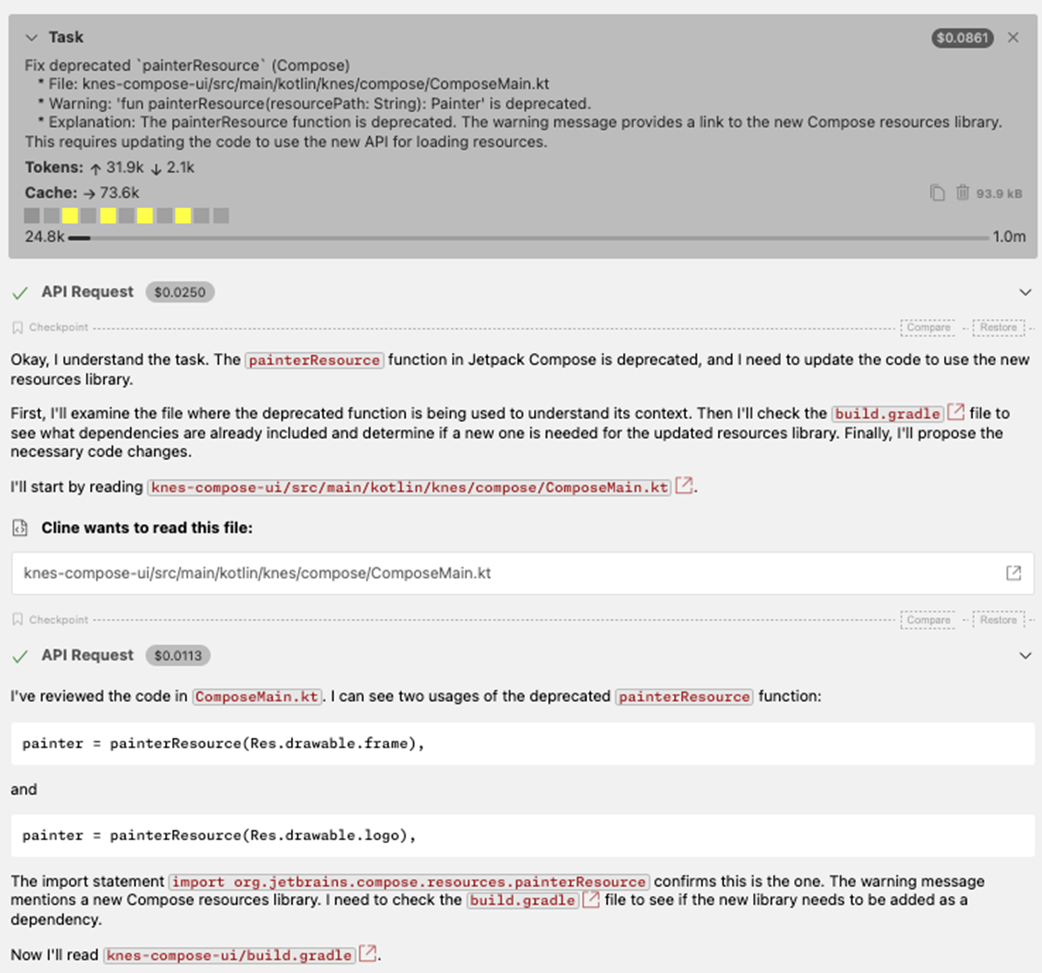
Review the execution-plan figure alongside the human-approval figure to inspect how deliberation becomes an auditable agent workflow. section 3.6.1