liveBook · Manning

Client-server architecture

As explained in Podman in Action: Secure, rootless containers for Kubernetes, microservices, and more

A client-server application is software organized into clients that request services from a separate server process.

Client-server architecture separates a client that requests services from server processes that perform the work. Docker uses a Docker client, Docker daemon, containerd, and an OCI runtime; the container becomes a child of containerd rather than the client. section 1.3.3

Figure 1.8 Docker client-server architecture. The container is a direct descendant of containerd, not the Docker client. The kernel sees no relationship between the client program and the container.
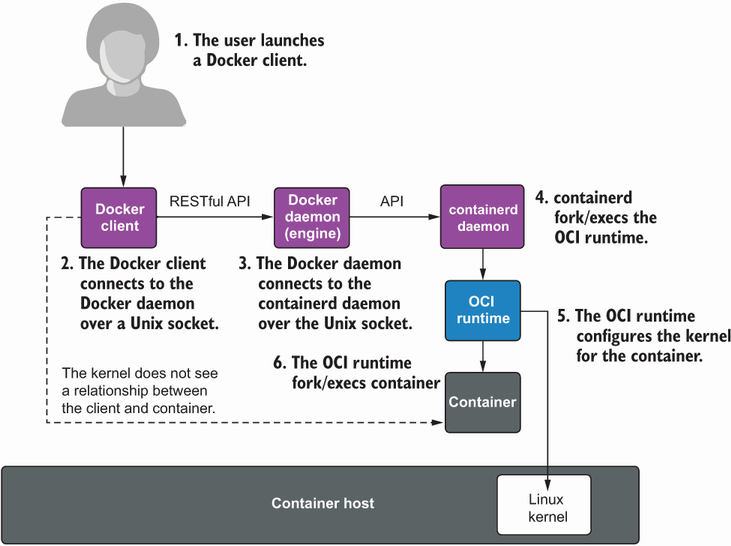
The architecture makes the process boundary visible: the kernel sees the container as a descendant of containerd, not of the Docker client. section 1.3.3

This indirection adds daemon failure points and complicates diagnosis. It also weakens user attribution: containers launched through a daemon inherit the daemon's loginuid, whereas fork/exec execution preserves the launching user's identity for kernel auditing. section 1.3.3 section 11.1.2

Inspecting process attribution

A Podman container inspected with `podman inspect -l --format '{{ .State.Pid }}'` retains the user's loginuid, while an equivalent Docker container reports `4294967295`, the kernel's representation of an unset loginuid. section 11.1.2


How Podman in Action: Secure, rootless containers for Kubernetes, microservices, and more covers it

How deep it goes
Traces client, daemon, containerd, OCI runtime, process ancestry, and loginuid effects, but stops short of daemon implementation internals.
Examples
Uses architecture diagrams, container process inspection, loginuid output, and audit records for host-file modification.
What it assumes
Assumes familiarity with containers and Linux processes while defining client, daemon, containerd, OCI runtime, and loginuid roles.
What you can do after
Diagnose process ancestry and user attribution by inspecting container PIDs, loginuid values, and audit records.
How it connects
Connects Docker clients with daemons, containerd, OCI runtimes, Podman, fork/exec, Linux processes, and kernel auditing.

Also explained in

Compare how 8 books explain client-server architecture →

Related concepts

This explainer was generated by Manning's knowledge graph from the text of Podman in Action: Secure, rootless containers for Kubernetes, microservices, and more. The section links point to the parts of the book it draws on.