What happens when an idea leaves your head? Collaboration is the social work of developing, refining, and improving ideas with other people. Feedback turns a slightly original idea into a stronger one, while peers can act as catalysts for change. Creative work is therefore not only about having ideas, but also about the interplay among ideas, individuals, and teams. section 1.4.1
Teamwork matters especially when software grows beyond a neatly bounded individual task. It helps people carry difficult projects forward, sustain motivation, and learn individually, within teams, and across teams. Historical gatherings such as the Peripatetics and the Camerata illustrate collective creativity: achievements can depend on a group rather than on isolated genius. section 3.1
Treat collaboration as an active creative habit:
- Invite feedback before treating an initial idea as finished; refinement needs another perspective. section 1.4.1
- Think along with others about an end-to-end solution instead of limiting attention to one technical problem. section 9.2.1
- Discuss alternative paths and evaluate them rather than automatically following a familiar route. section 9.2.1
From a solo problem to a shared solution
A junior programmer may experience creativity as the freedom to bootstrap a greenfield project alone. More experienced programmers often place creativity in discussing an end-to-end solution with others and considering alternative roads. Neither view makes technical work disappear; the shift is from solving a bounded problem alone to shaping a living project together. section 9.2.1
Figure 9.1 The academia-industry gap as illustrated by Adam Barr. University focuses on small programming problems, mostly at the individual level, while industry expects collaboration on big projects.
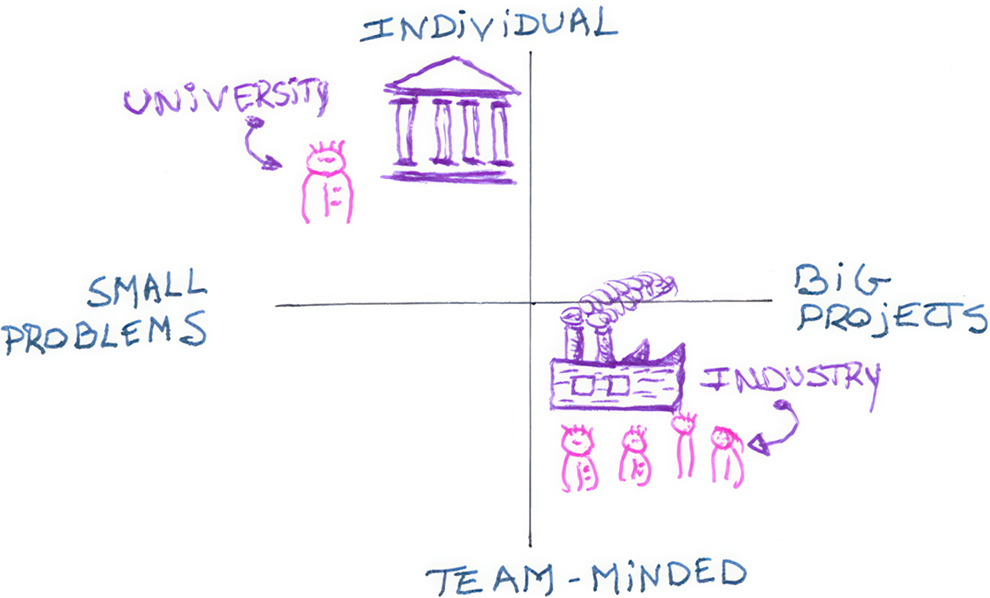
Use the figure to contrast small, individual university exercises with the larger collaborative projects expected in industry. section 9.2.1
Collaboration is not a magic substitute for judgment. It works alongside critical thinking: generate possibilities with others, then examine alternatives carefully. Experience can strengthen ideation when an environment provides support for creativity, while openness to new perspectives may become harder over time. section 9.2.1 section 9.2






