Multicollinearity occurs when regression predictors are highly correlated, making it difficult to distinguish their individual effects. Coefficient standard errors rise, and identical predictors produce infinitely many coefficient solutions. section 7.4.1
Consider estimating Y from treatment predictor X while adding Z. If X is nearly a copy of Z, the regression cannot reliably decide how much effect belongs to either variable. Adding Z can therefore increase uncertainty rather than improve estimation. section 7.4.1
A synthetic regression experiment
Generate Z, define X as Z plus small noise, and define Y as 3X plus noise. Regressing Y on X gives X a standard deviation of 0.08915; adding Z raises it to 0.41669, while estimated coefficients become unstable. section 7.4.1
Table 7.13 These controls are neutral in terms of bias, but not variance. The outcome predictor generally decreases the variance of your estimations, whereas the treatment predictor may increase them.
Outcome predictor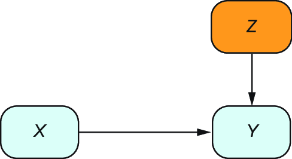
|
Treatment predictor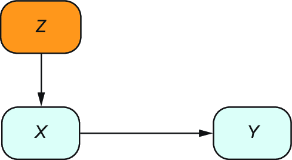
|
Compare outcome-predictor and treatment-predictor controls, which can have opposite effects on estimation variance. section 7.4.1






