liveBook · Manning

Community

As explained in Domain-Specific Small Language Models

A group of graph nodes that are more densely connected to each other than to the rest of the graph.

A community is a group of graph nodes that are more densely connected to one another than to the rest of the graph. In GraphRAG, communities are detected and summarized during indexing, then reused at query time to help answer questions over a knowledge graph. section 14.1

Used here to:

  • cluster related entities before summarization. section 14.1
  • support partial responses from multiple graph regions. section 14.1
  • improve coverage and diversity compared with conventional RAG. section 14.1

GraphRAG workflow

Source text is chunked, entities and relationships are extracted into a knowledge graph, communities are detected, and each community is summarized for later query-time use. section 14.1

Figure 14.1 The logical blocks and workflow of Microsoft’s GraphRAG proposal
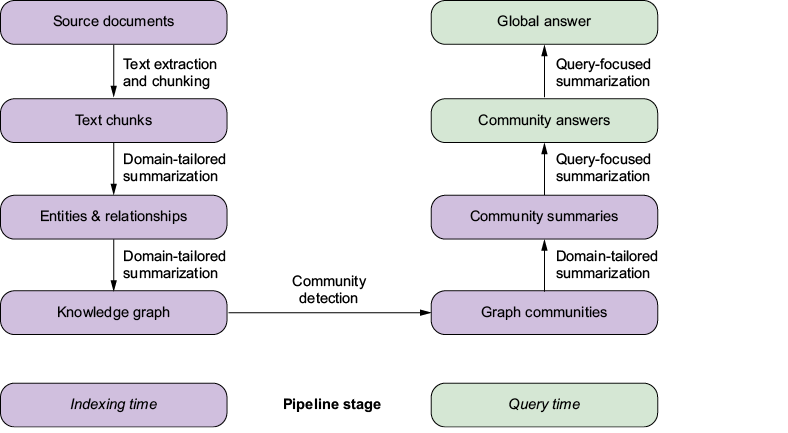
Shows the overall GraphRAG workflow where communities are created during indexing and consumed during query answering. section 14.1


How Domain-Specific Small Language Models covers it

How deep it goes
Defines the term and shows how GraphRAG detects, summarizes, and reuses communities, but stops short of full community-detection theory.
Examples
Uses a movie-database graph and the GraphRAG workflow diagram as teaching examples.
What it assumes
Assumes familiarity with graphs and knowledge-graph nodes and edges, and defines community from there.
What you can do after
Evaluate and apply community summaries to improve question answering over a knowledge graph.
How it connects
Connects to GraphRAG, knowledge graphs, entity extraction, modularity, and the Leiden algorithm.

Also explained in

Compare how 4 books explain community →

Related concepts

This explainer was generated by Manning's knowledge graph from the text of Domain-Specific Small Language Models. The section links point to the parts of the book it draws on.

