A community is a densely interconnected group of nodes whose members have comparatively fewer connections to other groups. In a social graph, it resembles a friend group: people in the group connect often, while an occasional outside connection does not merge two groups into one community. section 1.1 section 5.1
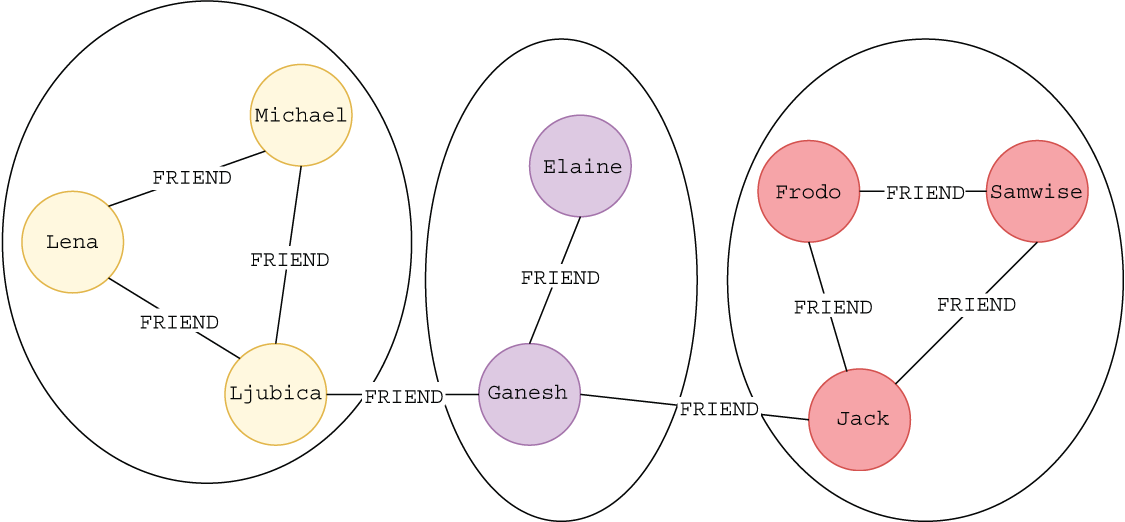
Outlined groups make the distinction visible: Frodo, Samwise, and Jack form a community because they are mutually connected, while Jack’s tie to Ganesh alone is not enough to include Ganesh. section 5.1
Community detection, also called clustering, assigns graph structure to interpretable groups. It can reveal multiple groups in a central network and distinguish isolated, disconnected nodes from the main graph. The resulting groups can support content or friendship recommendations, marketing segmentation, and network characterization. section 1.1 section 5.1
Finding hashtag groups
For hashtag analysis, first turn tweet–hashtag data into a hashtag co-occurrence network: match two tags attached to the same tweet and create a CO_OCCURRENCE relationship. Then use label propagation to evaluate its community structure, identifying groups of related tags for a hashtag-targeting task. section 7.0
Listing 7.1 Describing the construction of a hashtag co-occurrence network with a Cypher statement
MATCH (s:Tag)<-[:HAS_TAG]-(:Tweet)-[:HAS_TAG]->(t:Tag)
CREATE (s)-[:CO_OCCURRENCE]->(t);
This Cypher pattern connects tags that occur on the same tweet, producing a monopartite network suitable for subsequent graph analysis. section 7.0



