Completeness measures whether all data required for an intended analysis or operation is present. It is a core dimension of data quality: missing fields can make information unreliable or unusable for decisions. section 11.3.2
Handle incomplete data by:
- Removing records when missing information makes them unsuitable. section 11.3.2
- Inferring missing values, such as replacing nulls with a mean. section 11.3.2
- Deriving missing information from other data sources. section 11.3.2
- Checking completeness proactively during transformation in ETL or ELT workflows. section 11.3.2
Required fields and missing-value checks
A page_views table may require user_id and timestamp for analysis. A validation test can check that no values are missing; failures should be corrected before the data reaches users. section 11.3.2
Figure 11.13 Data without quality checks can be challenging to use and generate insights with.
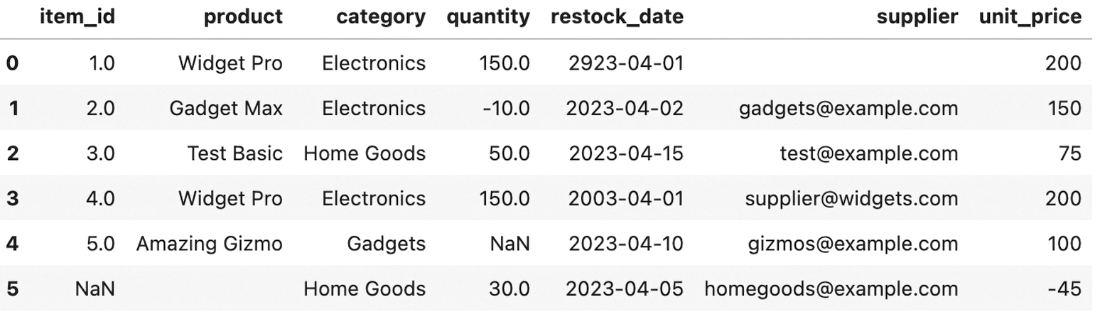
Inspect how incomplete rows appear alongside other data-quality problems in a dataset. section 11.3.2





