liveBook · Manning

Completeness

As explained in Think Distributed Systems

The property of a mental model in which every relevant fact of the system is represented in the model.

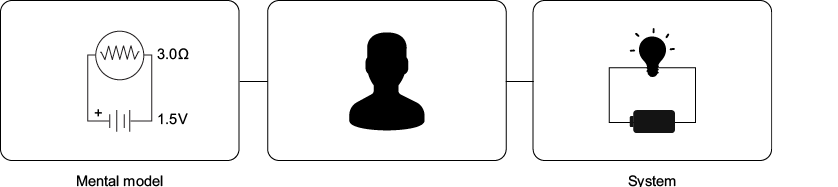
Completeness means representing every fact relevant to the question at hand in a mental model. Because no model captures everything, relevance depends on the purpose: a circuit model may predict current yet omit the luminous efficiency needed to predict brightness. section 1.1.1 section 1.1.3

Figure 1.1 Mental model and system
A black silhouette of a person

AI-generated content may be incorrect.

Use the system-and-model illustration to compare ground truth with the facts represented in a mental model. section 1.1.1

Transactions hide distributed-system facts

A money-transfer handler visibly subtracts from one account and adds to another, but it need not display concurrency or failure handling when transactional guarantees provide those protections. Undo records operations before execution, enabling either a complete commit or an abort that restores the prior state. section 5.2 section 5.3.3


How Think Distributed Systems covers it

How deep it goes
Defines relevance precisely, illustrates omission, and connects completeness to transactional Undo recovery.
Examples
Uses an electric circuit, light-bulb brightness, and a transactional money-transfer endpoint.
What it assumes
Assumes only the distinction between a system's facts and a mental model's perceived facts.
What you can do after
Evaluate whether a model omits facts needed for a specific prediction or system guarantee.
How it connects
Connects completeness with correctness, mental models, transactions, failure recovery, Undo, and Redo.

Also explained in

Compare how 6 books explain completeness →

Related concepts

This explainer was generated by Manning's knowledge graph from the text of Think Distributed Systems. The section links point to the parts of the book it draws on.



