Component evolution positions a capability on a Wardley Map according to its maturity and evolutionary position. The usual stages are genesis, custom built, product, and commodity, but assigning a stage requires contextual judgment rather than a precise formula. section 5.3 section 5.3.1
Assess a component through three weak-signal characteristics:
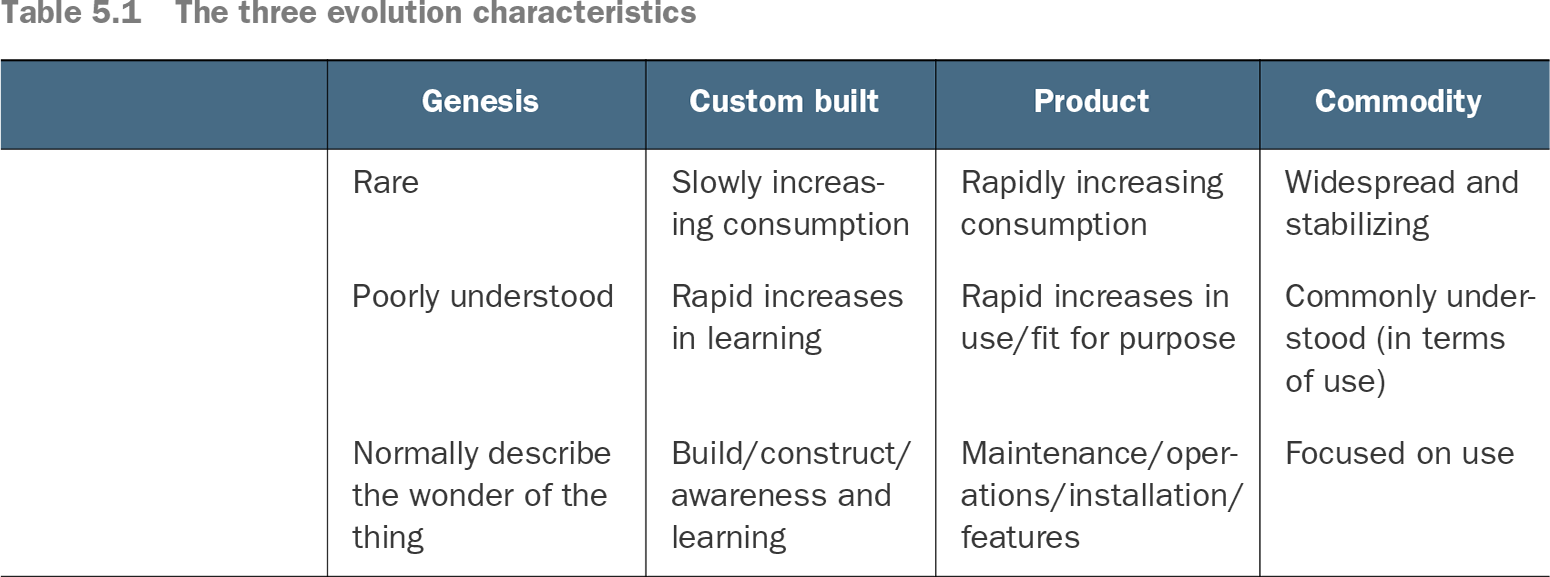
- Ubiquity ranges from rare capabilities in genesis to widespread, stabilizing capabilities in commodity. section 5.3.1
- Certainty ranges from poorly understood use in genesis to commonly understood use in commodity. section 5.3.1
- Publication types shift from describing a thing’s wonder, through building and operating it, toward guidance focused on use. section 5.3.1
Menus, restaurant optimization, and Miro
In online food delivery, menus are widespread and commonly understood, so they resemble a commodity. Restaurant optimization, by contrast, is being developed and tested by only a few organizations, placing it nearer genesis. Miro demonstrates that movement is not necessarily gradual: pandemic-driven demand helped it reach 30 million users by January 2022 after growing 500% in two years. section 5.3.1 section 5.4.4
Table 5.1 The three evolution characteristics (view table figure)
Compare genesis, custom-built, product, and commodity stages across ubiquity, certainty, and publication types. section 5.3.1
Treat stages as signals, not a guaranteed sequence. Examine how quickly components have evolved, watch for changes in pace, and identify architectural or organizational bottlenecks before the landscape intensifies. section 5.4.4