Querying cost is the expense of evaluating an objective at a chosen fidelity. The expense may be time, money, effort, or another application-defined unit. In multifidelity optimization, high-fidelity evaluations provide exact information about the target objective but are costly, while low-fidelity approximations are cheaper and provide inexact yet useful information. section 9.1 section 9.3.1
Represent cost with a cost model that maps a data point and its fidelity indicator to a known evaluation cost. A linear model can assign a fixed cost plus a weighted fidelity value: higher correlation with the ground truth corresponds to higher cost. For example, with fixed cost 0 and weight 1, a fidelity value of 0.5 costs 0.5 units and the target fidelity value of 1 costs 1 unit. section 9.3.1
Figure 9.9 The linear cost model for multifidelity optimization. The cost of querying a data point on a fidelity scales linearly with the correlation between that fidelity and the ground truth f(x).
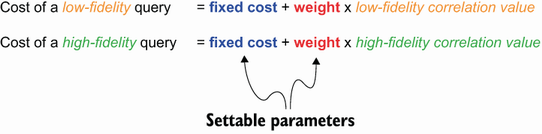
A linear cost curve makes the modeling assumption visible: cost rises with a fidelity’s correlation to the ground-truth objective. section 9.3.1
Cost matters because a useful query is not simply the most informative one; it is the one that makes sufficient optimization progress for its expense. A cost-aware multifidelity policy combines an information-gain measure with querying cost using a return-on-investment score: information about the optimum per unit cost. This can favor inexpensive low-fidelity queries, but favors high fidelity when low-fidelity data are insufficient or nearly as expensive. section 9.3.2 section 9.7
Cost-aware fidelity choice
For a simulation with adjustable quality, a coarse run can return quickly and offer an approximate result, while a high-quality run takes longer and better matches reality. Treating each run’s expense as querying cost lets an optimizer compare the information each fidelity offers against what it consumes. section 9.1 section 9.3.2
A practical cost-aware workflow is:
- Assign each available fidelity a known cost in units meaningful to the application. section 9.3.1
- Fit the multifidelity model so low-fidelity observations can inform the target objective. section 9.7
- Score candidate queries by information gain weighted inversely by cost. section 9.3.2
- Optimize across continuous inputs and discrete fidelity choices to select the next evaluation. section 9.7









