Confidentiality limits access to systems and data to authorized entities. It is one goal of the CIA triad, alongside integrity and availability: integrity protects trustworthiness, while availability keeps resources usable when required. section 11.1.1
In wired LANs, cables contain signals and reduce—but do not eliminate—the risk of unauthorized access. Wireless LANs expose signals to any receiver within range, so communications require protection while traveling through the air. Encryption converts a message into unintelligible ciphertext that only the intended recipient can restore. Cleartext is information that will not be encrypted; plaintext is information awaiting encryption. section 20.1.1
Unencrypted wireless login
A nearby attacker can overhear unencrypted login information transmitted over a wireless LAN. Encrypting the wireless communication prevents the captured signal from directly revealing the message, addressing confidentiality rather than guaranteeing integrity. section 20.1.1
Use confidentiality to classify security effects and protections:
- Treat unauthorized reading or interception as a confidentiality failure. section 11.1.1 section 20.1.1
- Separate confidentiality from integrity: encryption can prevent reading while failing to prevent malicious alteration, such as bit flipping. section 20.1.1
- Relate attacks to the CIA triad: man-in-the-middle and ARP poisoning can expose intercepted communications, while DoS primarily attacks availability. section 11.2.1 section 11.6
Figure 11.1 The CIA triad. Confidentiality protects systems and data from unauthorized access, integrity ensures that systems and data are trustworthy, and availability ensures that systems and data remain available to authorized users.
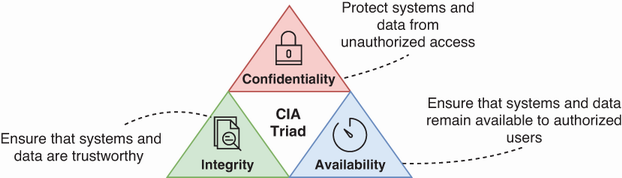
Compare confidentiality, integrity, and availability as the three coordinated goals of information security. section 11.1.1








