Confidentiality keeps information from being read by unauthorized parties. It protects privacy when data crosses trust boundaries, such as a customer browser, an e-commerce service, and a payment API. section 4.1
Treat confidentiality as one goal among several cryptographic protections:
- Use encryption to protect the contents of data; symmetric and public-key encryption are the foundational algorithm types for confidentiality. section 4.1
- Do not confuse confidentiality with integrity or authentication: encryption hides contents, while integrity detects changes and authentication confirms the sender. section 4.1
- Protect data in applications, cloud services, disk storage, and networking protocols rather than treating confidentiality as only a web concern. section 5.0
Protecting refund data
ACME sends a refunds.json file from its warehouse service to a payments service. An HMAC can detect tampering, but it does not hide order IDs or amounts. Encrypting the file adds confidentiality; JWE provides an industry-standard JSON-based format for encrypted content with integrity protection. section 5.3.1 section 11.5
Figure 4.1 A typical high-level e-commerce architecture. Customers place orders using ACME’s web applications, which call the Payments, Inc. credit card API to collect payment while processing an order.
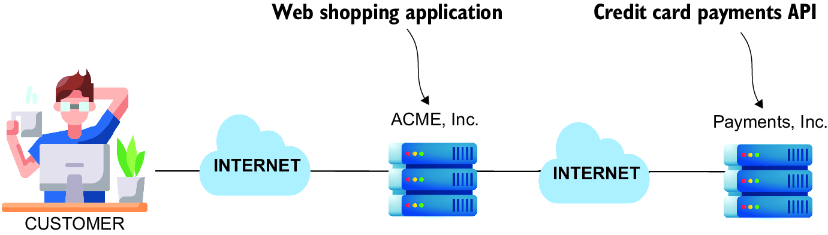
Trace confidentiality across the browser, e-commerce application, and payment service in a typical production architecture. section 4.1








