Confidentiality keeps information away from unauthorized eyes. On an exposed network, an observer could read passwords, payment details, private messages, or other data in transit. section 1.5 section 9.1
Encryption provides confidentiality by transforming readable plaintext into ciphertext that looks random during transmission. The intended recipient uses the appropriate key to recover the plaintext. section 4.1
Confidentiality appears through several cryptographic arrangements:
- Symmetric encryption uses one shared key for encryption and decryption. section 4.1
- Asymmetric encryption lets anyone encrypt with a public key, while only the private-key holder decrypts. section 1.4.2
- Secure transport applies confidentiality to browser–server communication, as HTTPS does for HTTP. section 9.1
Alice sends “hello”
Alice encrypts “hello” with a shared secret key and sends the ciphertext to Bob. Bob uses the same key to decrypt it. With asymmetric encryption, anyone instead encrypts for Alice using her public key, and only her private key decrypts the message. section 4.1 section 1.4.2
Figure 4.1 Alice (top right) encrypts the plaintext hello with the key 0x8866... (an abbreviated hexadecimal). Then Alice sends the ciphertext to Bob. Bob (bottom right) decrypts the received ciphertext by using the same key and a decryption algorithm.
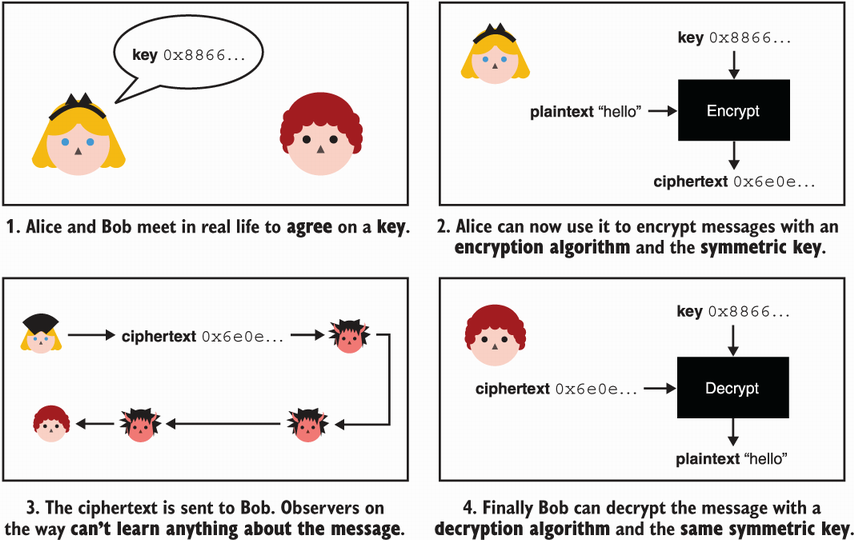
Follow the plaintext-to-ciphertext-to-plaintext flow to see how a shared key protects a message in transit. section 4.1








