Suppose players who engage in more side quests also make more in-game purchases. Does increasing engagement cause purchases to rise? A confounder is a common cause of the treatment and outcome that creates a noncausal association between them. A causal DAG distinguishes the effect of engagement on purchases from an open backdoor path through that common cause. section 4.1.2 section 11.1
Figure 10.8 E←G→I is a backdoor path where G is a “confounder” that is a common cause of E and I. We are interested in the statistical signal flowing along the causal path from E to I, but that signal is “confounded” by the noncausal noise from additional statistical information through G on the backdoor path E←G→I.
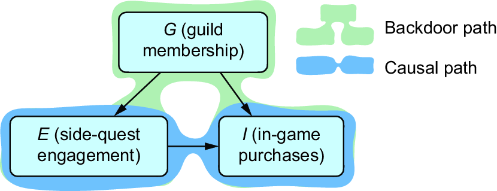
The diagram separates the treatment-to-outcome path from the backdoor path through a common cause. section 10.3.1
A hidden confounder is an unobserved common cause. If prior experience directly affects both side-quest engagement and purchases, but is unavailable for adjustment, it can bias the estimated effect. Unobserved does not always mean fatal: a measured adjustment set may still block every backdoor path. What matters is whether the proposed adjustment set blocks the relevant paths, not whether every common cause was measured. section 11.3.1 section 11.3.4
A practical workflow makes the confounding assumption explicit:
- Draw the treatment, outcome, and plausible common causes in a DAG. Include variables relevant to the question and trace their shared causal ancestry. section 3.3.1
- Choose an adjustment set that blocks all backdoor paths without including descendants of the treatment. For an observed confounder G, backdoor adjustment averages P(Y=y | X=x, G=g) over the distribution of G. section 10.3.1
- Estimate the identified effect. In the gaming example, linear regression includes engagement and the identified confounders; propensity-score methods instead use treatment probability conditional on those confounders. section 11.4.1 section 11.4.2
- Check sensitivity to a missing common cause. If no observed set blocks every backdoor path, reconsider identification; an instrumental-variable or front-door estimand may be available under its own assumptions. section 11.5.5 section 11.3.4
When the adjustment set changes
Guild membership, time spent playing, and player skill level form the adjustment set used to estimate the effect of side-quest engagement on purchases. If only guild membership is observed, the backdoor estimand is no longer identified. A latent-variable model can still return an effect estimate, but without graphical identification, more data alone cannot eliminate confounder bias. section 11.4.1 section 11.6.3 section 11.6.7
Figure 11.11 A heatmap illustrating the effects of adding an unobserved confounder on the ATE estimate
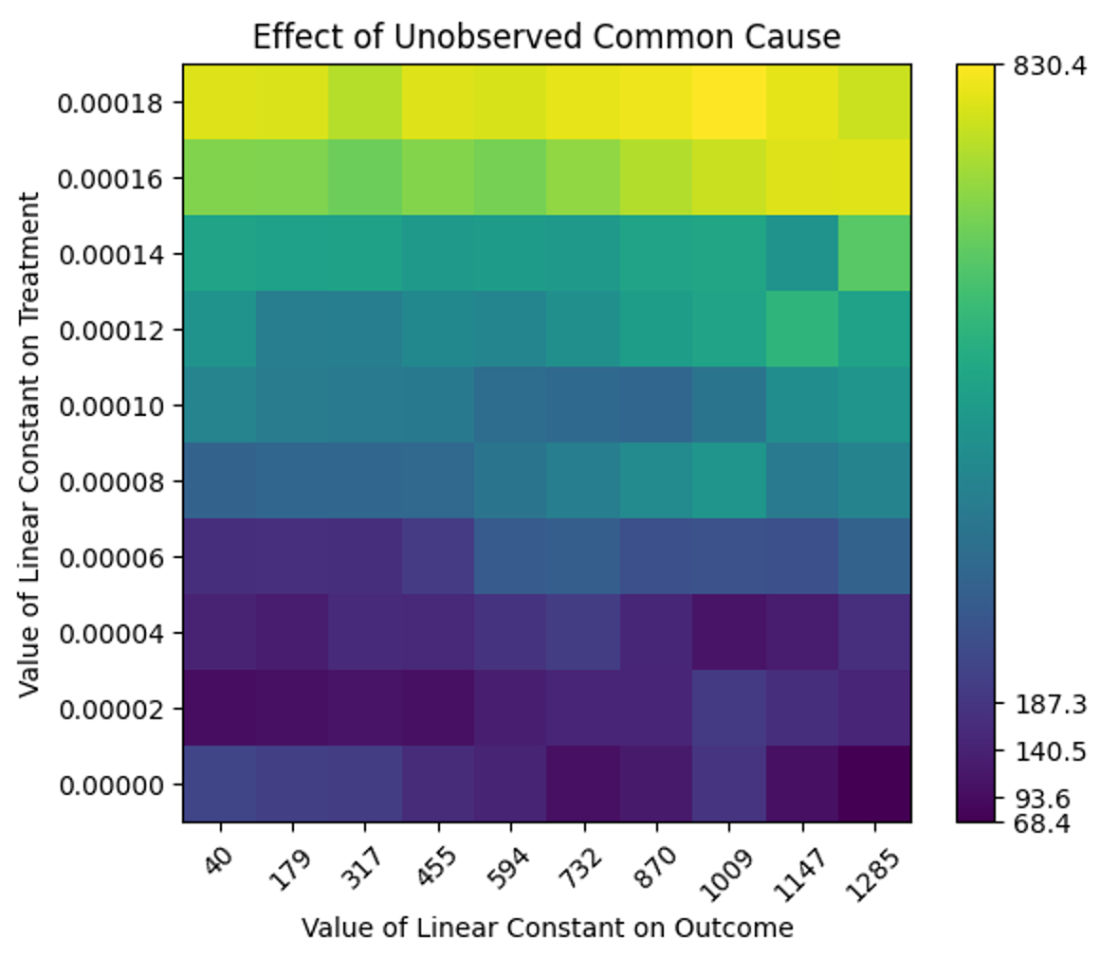
The heatmap shows how an estimated effect changes as a hypothetical unobserved confounder’s influence on treatment and outcome varies. section 11.5.5




