Consistency is a guarantee governing when updates become visible and how operations are ordered across replicated copies. Replication improves availability and latency, but keeping copies synchronized creates a trade-off among consistency, availability, and latency. section 4.0 section 4.3
A consistency model specifies whether a write is immediately visible across copies and, if not, when readers can expect visibility. Strong consistency, also called linearizability, gives the illusion of one copy: each operation observes the latest state, at the cost of coordination and latency. section 4.3.1 section 4.3
Figure 4.1 An example of a linearizable key–value store with three replicas. Each of the replicas is in the same state after every operation because linearizability gives the illusion of a single copy of data being accessed and updated.
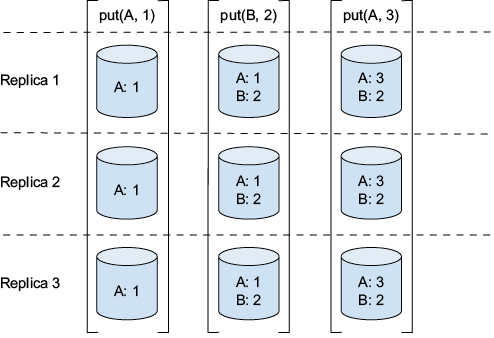
A three-replica key–value store shows linearizable operations updating every replica to the same state after each write. section 4.3.1
Choose consistency guarantees according to correctness and latency requirements:
- Use stronger guarantees when applications require the latest shared state; accept additional coordination and latency. section 4.0 section 4.3
- Distinguish linearizability from serializability: linearizability orders operations on a single object, while serializability governs multiple operations across objects. section 4.3.1
- Do not confuse distributed consistency with ACID consistency: distributed consistency concerns data visibility, while ACID consistency preserves database invariants. section 9.4
- Treat optimistic updates and predictive techniques as latency improvements that may require conflict resolution and tolerance for temporary inconsistency. section 11.6



















