A common mistake is to assume that reading the same elements must cost the same regardless of how the surrounding data is laid out. A CPU cache keeps recently accessed data and instructions closer to a core than main memory. On one example processor, L1 access takes about 1 ns, while main-memory access takes roughly 50–100 times longer. Those figures are hardware-specific, but the performance gap makes data layout worth examining. section 12.1.1
The CPU usually fetches a memory block into a cache line rather than fetching one value at a time. Reading nearby values makes more use of each line; this is spatial locality. Cache placement also matters: a set-associative cache partitions its lines into sets, so repeatedly accessing addresses that compete for a set can evict useful data. section 12.1.5 section 12.11
Same columns, different row width
Consider two Go matrices, `[][512]int64` and `[][513]int64`. For each row, sum only columns 0 through 7: ```go for i := range matrix { for j := 0; j < 8; j++ { sum += matrix[i][j] } } ``` The loop reads the same number of values either way, yet a benchmark that repeatedly reused its matrix found the 513-column version about 50% faster on one machine. When each benchmark used a new matrix, the difference disappeared. The row width changes memory addresses and therefore how blocks compete for cache placement; the result is not a rule that 513 columns are always faster. section 12.1.5
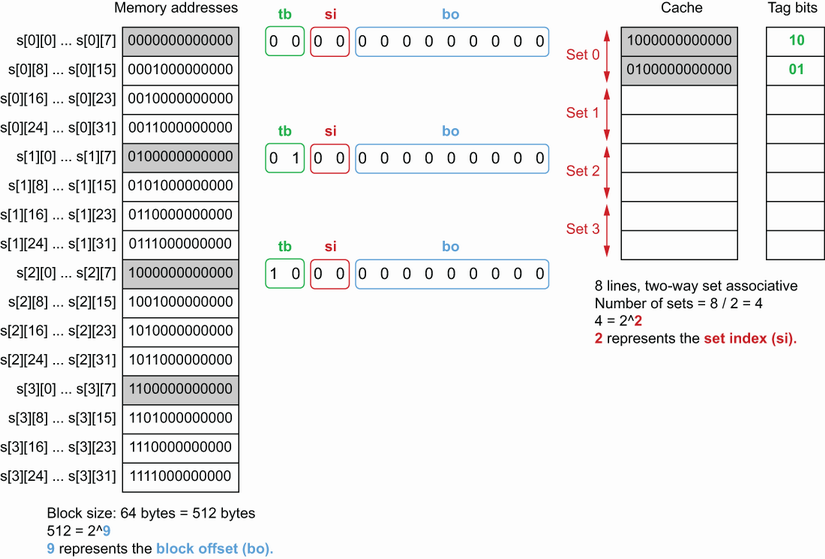
The illustrated replacement shows why a cache with available capacity can still lose a useful line when addresses map to the same set. section 12.1.5
When investigating a CPU-bound Go loop:
- Favor predictable access patterns and nearby data when the computation permits; a unit stride can use cache lines more effectively than a non-unit stride. section 12.11
- Consider cache-set conflicts if a repeated access pattern performs unexpectedly; benchmark the actual data layout rather than assuming fewer allocated elements means faster access. section 12.1.5
- In concurrent code, account for caches not being shared uniformly across cores and for performance losses from false sharing. section 12.11


