Creativity involves producing ideas, expressions, or artifacts that feel both novel and meaningful. Generative artificial intelligence does not make the human–machine comparison straightforward: large language models (LLMs) can generate poetry, conversation, images, and other outputs associated with creativity, while still making factual or mathematical mistakes. Their practical value is strongest when human imagination and judgment guide rapid machine generation. section 6.5
Human–AI creativity is best understood as collaboration rather than replacement:
- AI tools can rapidly produce many concepts or assets, reducing the time and cost of early creative work. section 6.5
- People remain responsible for selecting, combining, refining, and evaluating the final result. section 6.5
- Generated work may be incomplete or miss details that experienced professionals notice, so creative assistance does not remove the need for oversight. section 6.5
- Wider use raises questions about authorship, unequal access, job displacement, and how creativity and expertise should be defined. section 6.11
A collaborative advertisement
In a creative competition, one team used AI to generate advertising assets but assembled the final poster themselves. The human–AI collaboration scored higher for emotional response than entries made solely by humans or AI, illustrating acceleration without eliminating human contribution. section 6.5
Figure 6.3 An AI-generated advertisement, created with the prompt “poster for a new energy drink called Buzz” by the open source image generation model Stable Diffusion
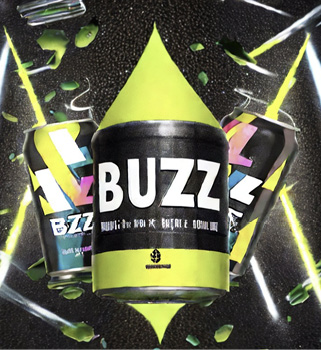
Shows an AI-generated advertisement for the energy drink “Buzz,” providing a concrete example of machine-generated creative imagery. section 6.5



