What makes a programming idea creative? Novelty alone is not enough. Creativity joins originality, quality, and relevance to the task—but its final status is social: peers and communities decide whether an idea counts. A solution can be new to one team yet familiar elsewhere, so context changes the verdict. section 1.1 section 1.3
In programming, creativity is useful when familiar methods stall and when the real problem has not yet been recognized. It can widen the search for possible approaches, such as caching, load balancing, message queuing, or coroutines for a struggling application, then help frame a problem worth solving. section 1.2
Treat creativity as a set of practical habits rather than a fixed talent:
- Build technical knowledge and varied input; new work grows from prior ideas, techniques, and connections. section 2.1
- Share unfinished ideas. Feedback and proximity to creative coworkers can improve, redirect, and spread inspiration. section 1.4.1 section 3.2.2
- Use constraints as material. Limits imposed by hardware, legacy systems, or deliberate rules can prompt unexpected approaches. section 4.1
- Pair idea generation with critical thinking. Test usefulness, seek feedback, and reject attractive solutions that miss context or function. section 5.1 section 5.3
A creative answer is not merely a strange answer
Calling a custom Ruby interpreter through Java Native Interface may sound inventive, but it can be irrelevant or impractical beside simpler alternatives. Creative work earns its value by fitting the problem, constraints, and people who must use or evaluate it. section 5.3 section 5.6
Figure 1.2 An example of different inner circles in which a programmer works. A piece of code deemed creative by close colleagues might bubble up and be lauded as creative by the team. However, another team might have done the same: at the company level, your fame comes to an abrupt end. Because creativity is socioculturally dependent, switching teams also changes the interpretation of creativity. Being mindful of these inner circles can be very useful. Helping the team and company be creative means spreading the word, but starting with yourself.
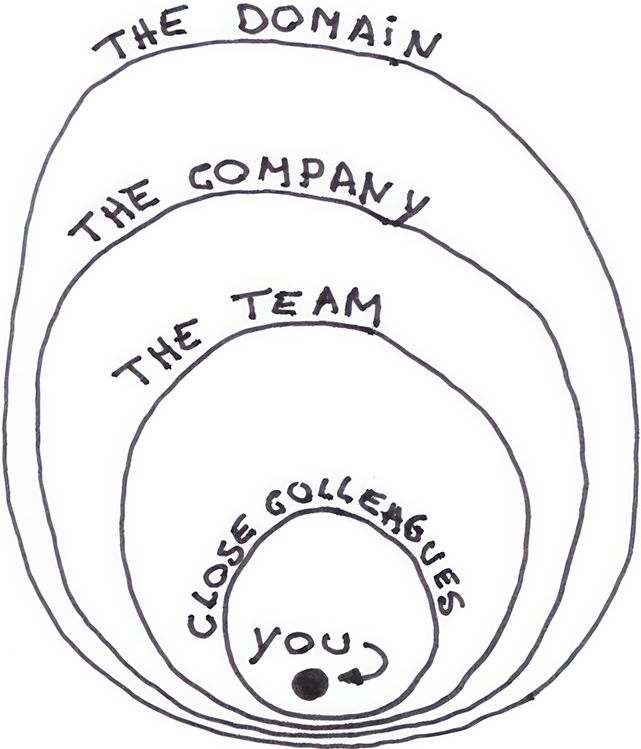
Compare the circles of colleagues, team, and company to see why the same code may be recognized as creative in one setting but not another. section 1.3



